 THE BARATELLI INSTITUTE
· Mentoring at Scale
THE BARATELLI INSTITUTE
· Mentoring at Scale
THE BARATELLI INSTITUTE
· Mentoring at Scale
THE BARATELLI INSTITUTE
· Mentoring at Scale
"None of this magically happens. GRATs require annual payments that can't be forgotten. It requires the Power of the Pack to maximize the strength of the estate-planning investment."
An estate plan goes into a desk drawer the day it's signed — and then the work begins. Trust administration is what happens for the next forty years. GRATs require annual payments on a specific schedule that cannot be forgotten. IDGT sales need their installment notes tracked. SLATs need their independent-trustee reviews. Dynasty trusts need their generation-tracking records maintained. Decanting needs to happen when the trust no longer fits. Situs needs to change when the state's tax position shifts. The fiduciary income tax mechanics no one explains until you are holding a Form 1041 you can't reconcile. This is the operating manual for the newly-named individual trustee on day one, the family-office staff, the CPA preparing the 1041, and the attorney administering the structures their colleagues drafted. The opening reframe: 'You've just been named trustee. Read this first.' Chapter 17 is the 30/90/365-day playbook for the brand-new trustee. The companion volume to Estate Planning Decoded — the creation guide builds the plan; this guide is what makes it actually deliver value for the next four decades.
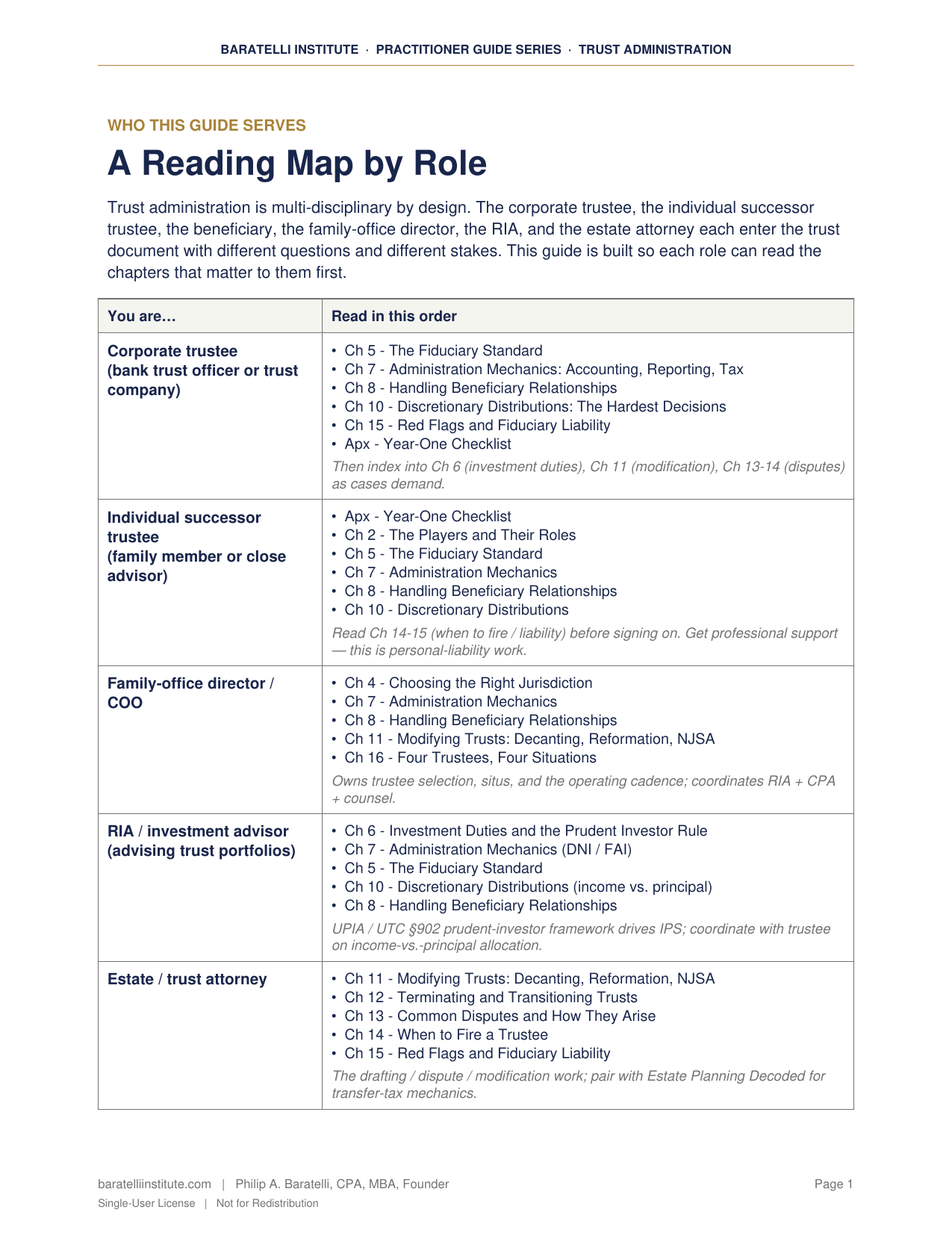
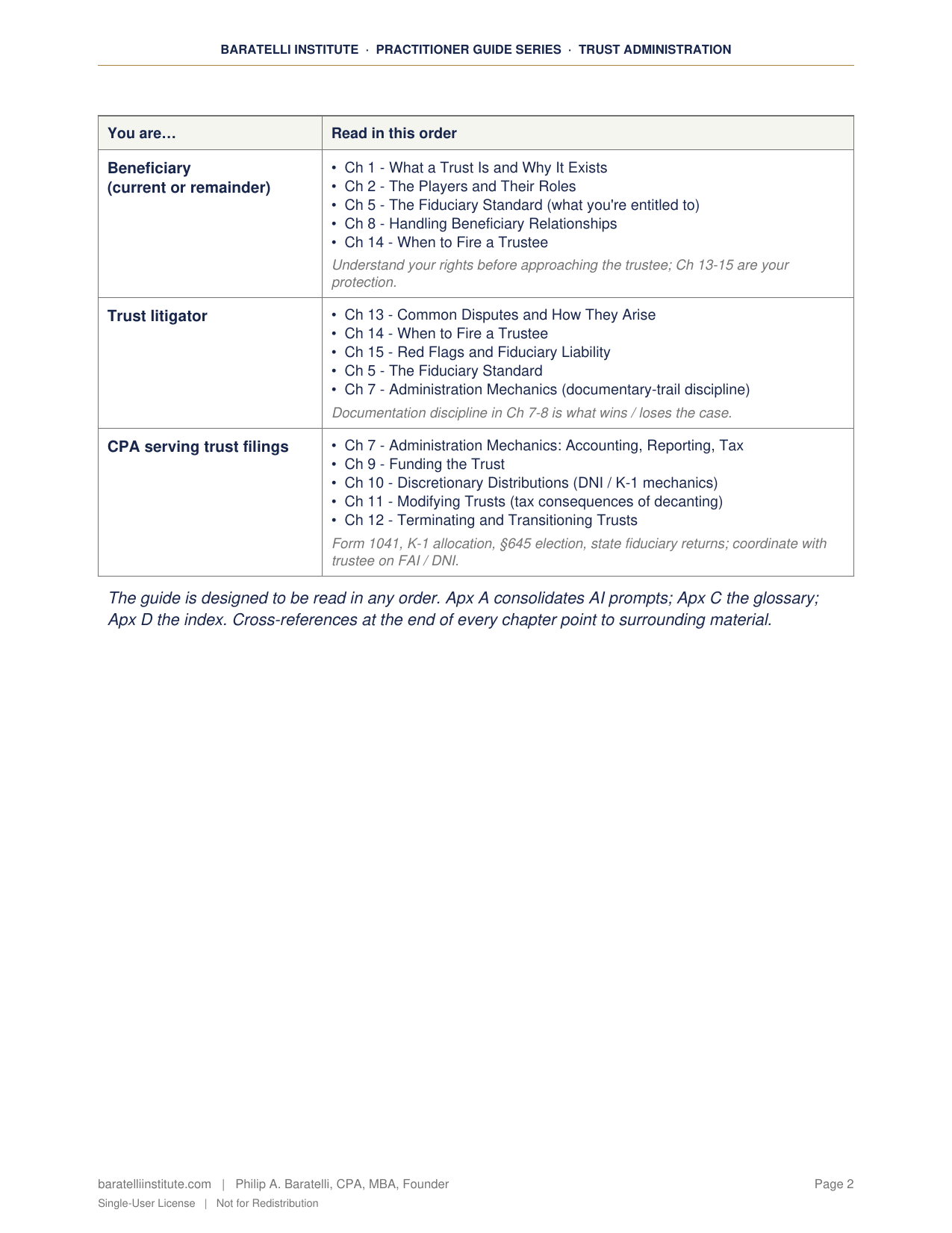
The guide is written for the actual professionals who do this work — and the people who serve them. Each section contains material that will be useful to multiple audiences, but the persona-routing table below tells you where to start.
| You are… | Start with these chapters |
|---|---|
| Individual trustee (often the surviving spouse or adult child) | Ch 1 What You Just Inherited · Ch 3 The First-Year Cadence · Ch 9 Distribution Decisions · Ch 12 Working With the Trust CPA · Ch 17 The Difficult Beneficiary Conversation |
| Corporate trustee at a bank or trust company | Ch 5 Investment Policy for the Trust · Ch 8 Distributions Under HEMS · Ch 13 §645 Election · Ch 14 DNI and Throwback · Ch 16 Situs Change |
| Family-office trust officer | Ch 4 Trustee Compensation · Ch 6 The Investment Committee · Ch 11 Trust Accounting · Ch 15 Decanting · Ch 18 Trustee Removal & Successor Trustee |
| Wealth advisor coordinating with the trust | Ch 5 IPS for the Trust · Ch 7 Trust-Level Asset Allocation · Ch 12 Trust CPA Coordination · Ch 16 Situs Change Mechanics |
| Trust beneficiary trying to understand the structure | Ch 1 What You Just Inherited (or What's About to Happen) · Ch 9 Distributions · Ch 17 The Conversation · Ch 19 What to Ask the Trustee |
Page counts are approximate.
Sample pages from the actual guide — cover, table of contents, persona routing, sample chapter openers, and back matter. These are the actual pages that ship; not marketing renders.
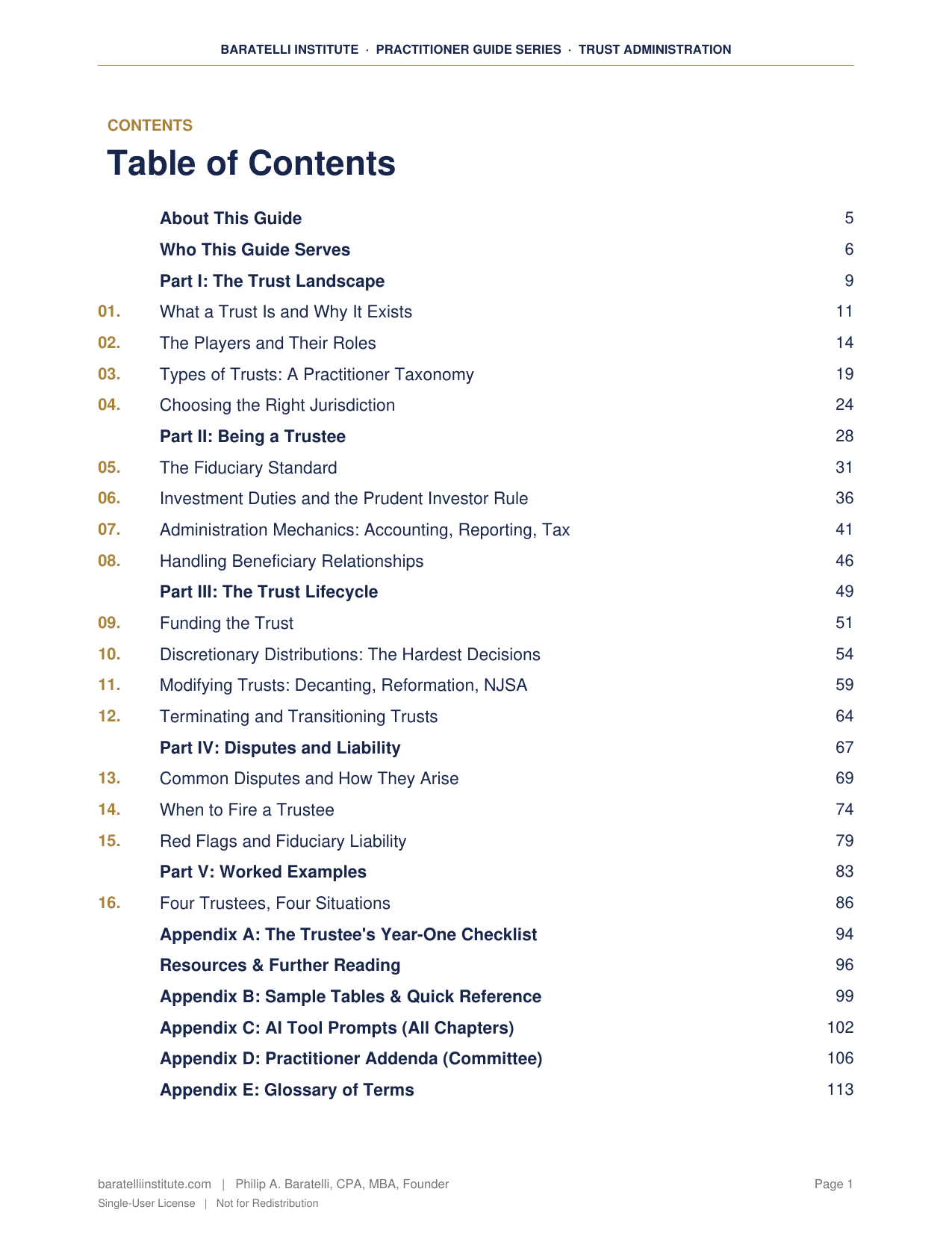
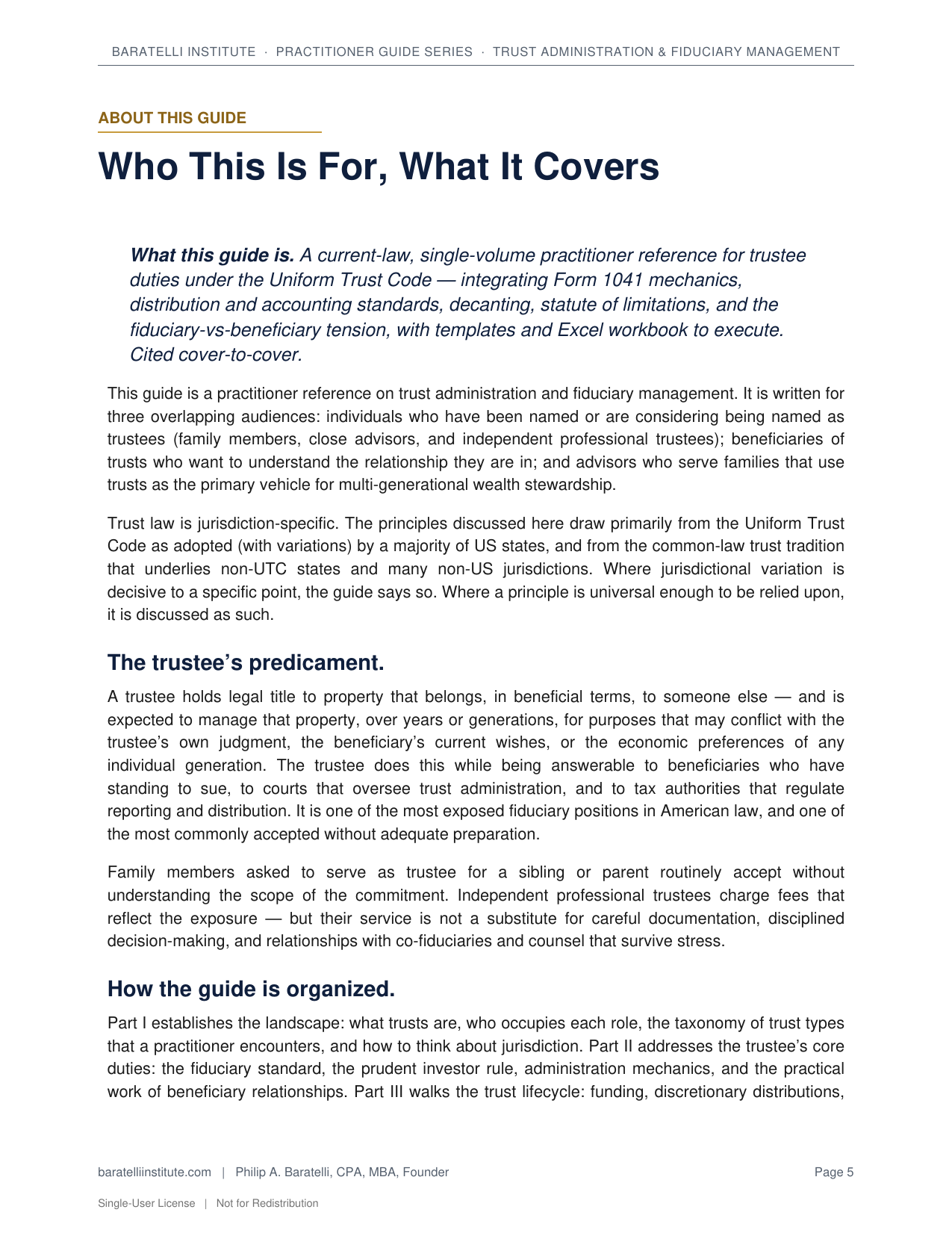
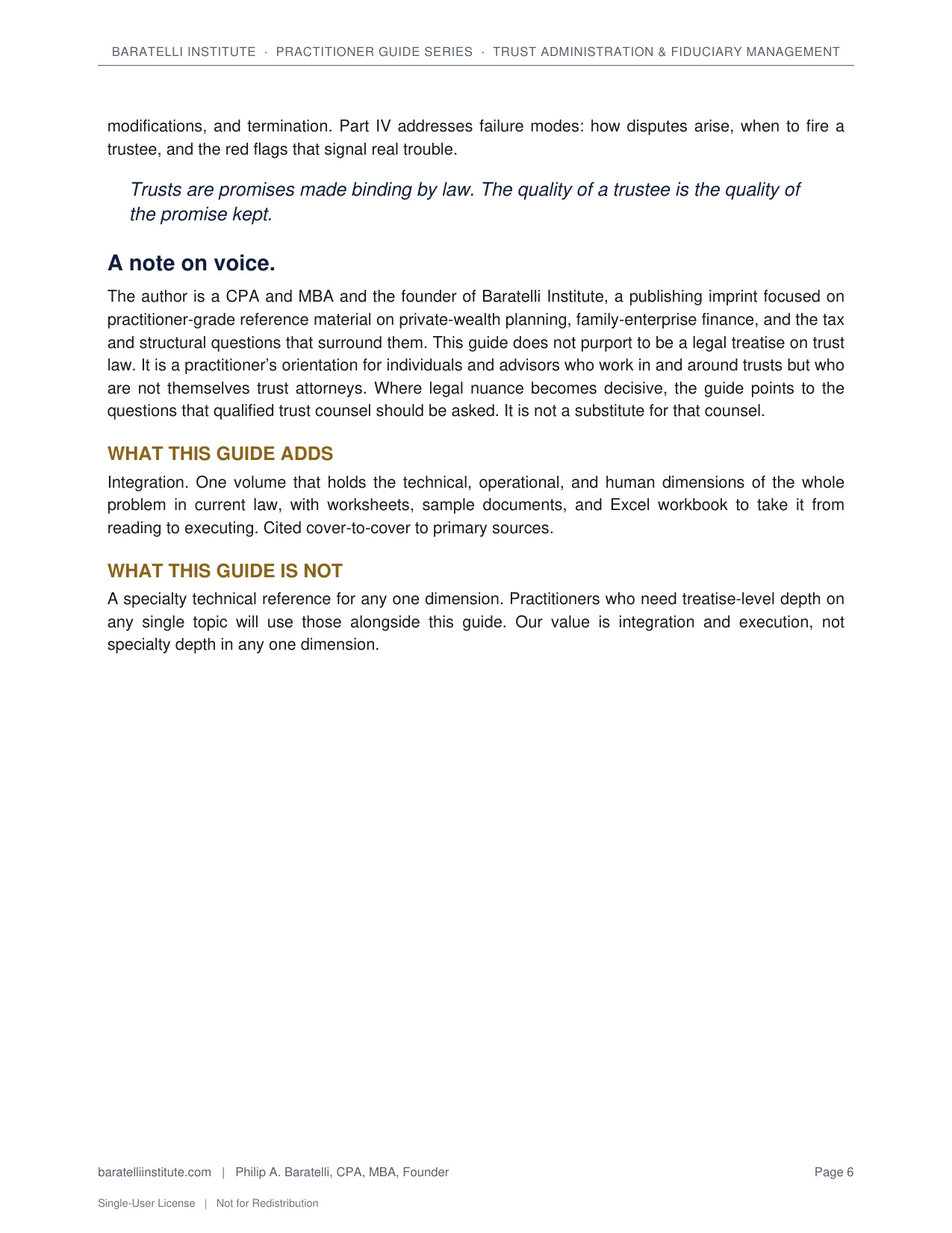
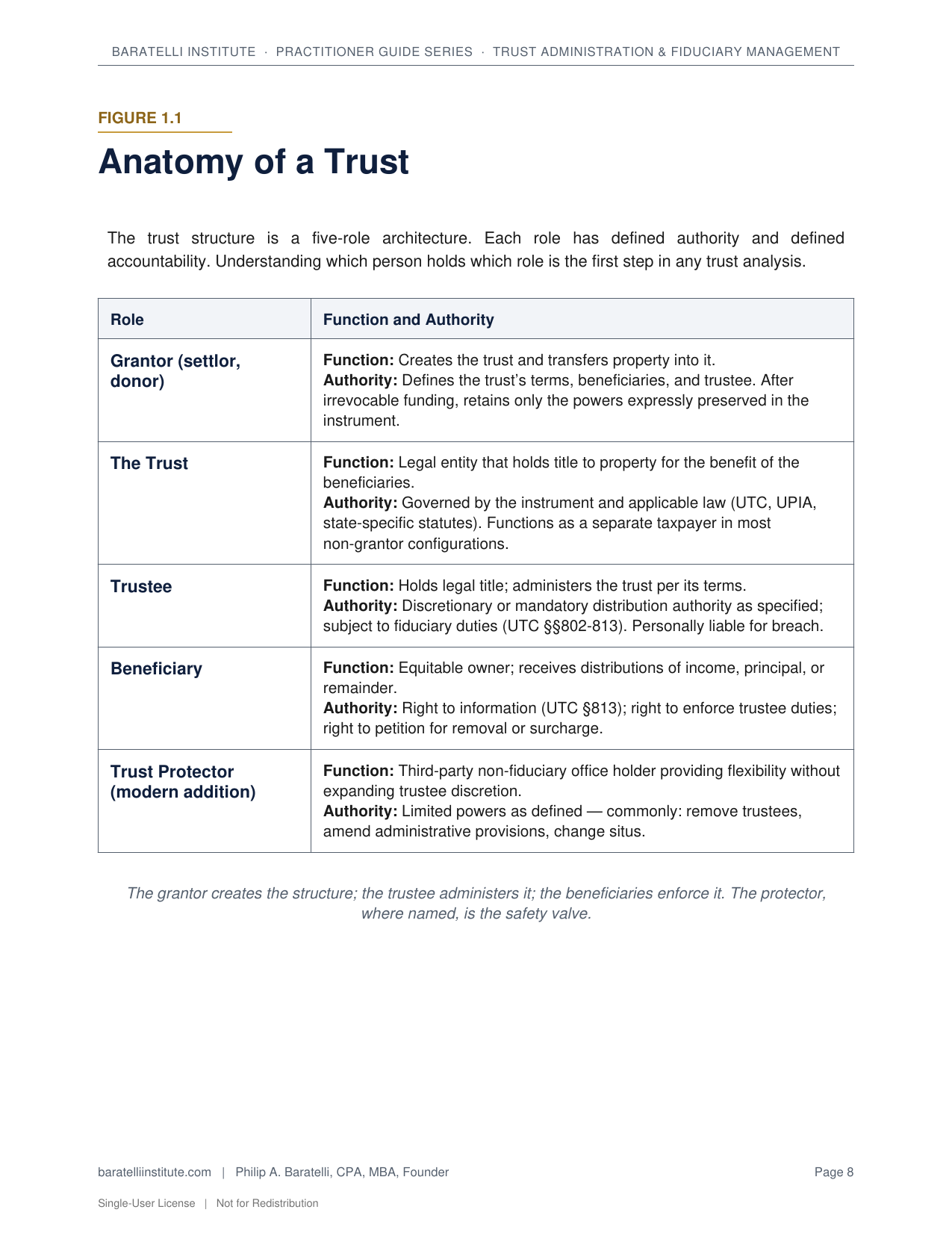
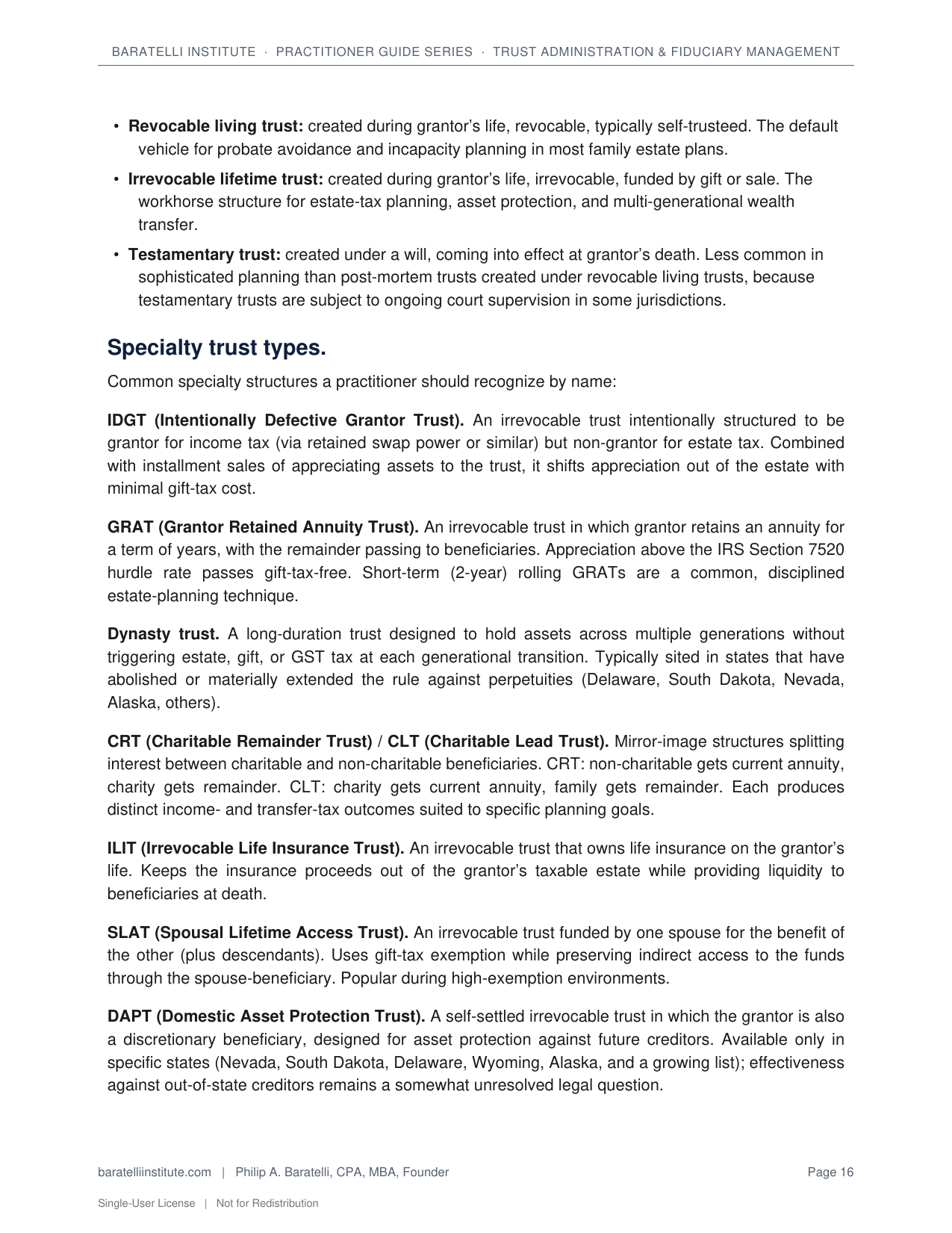
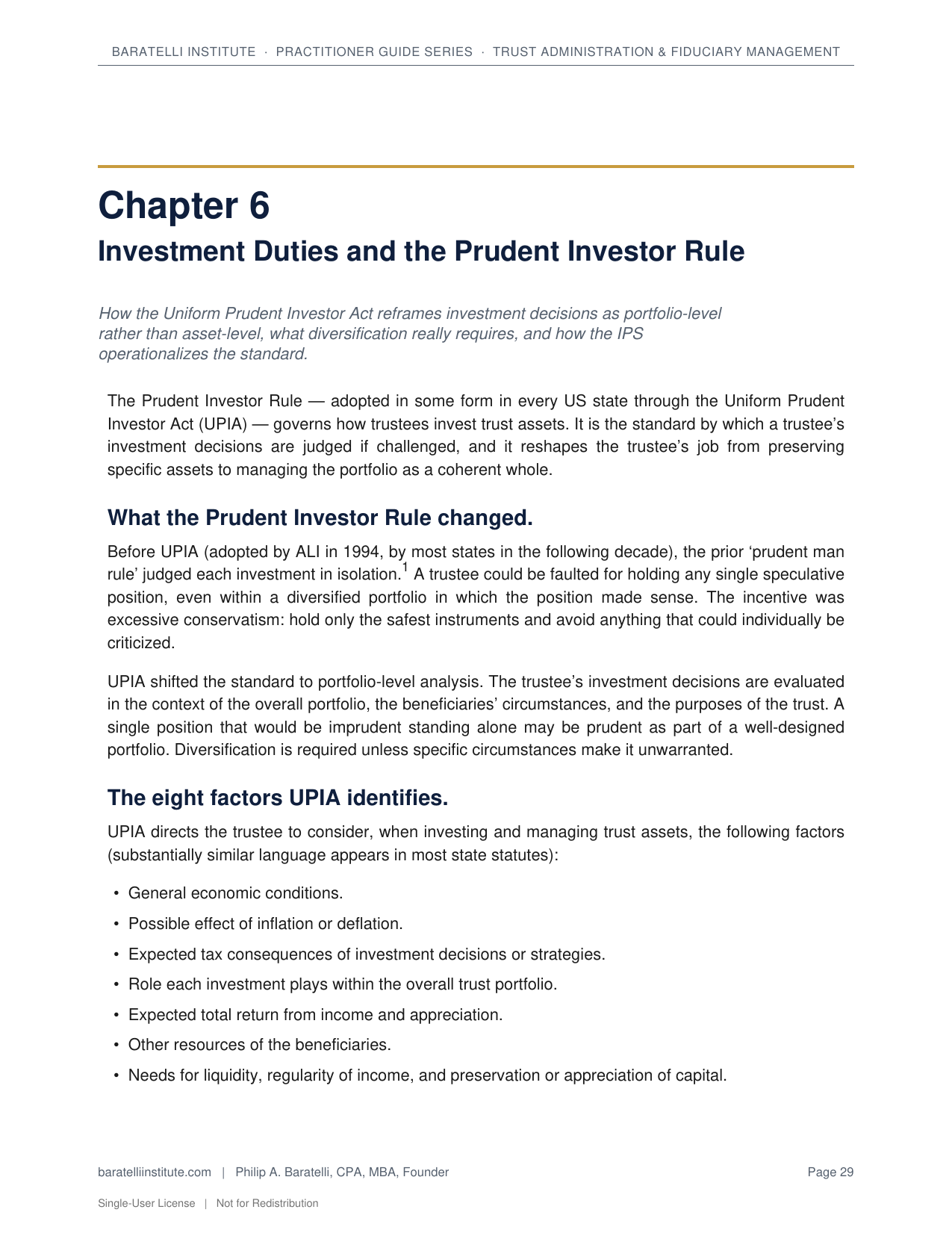
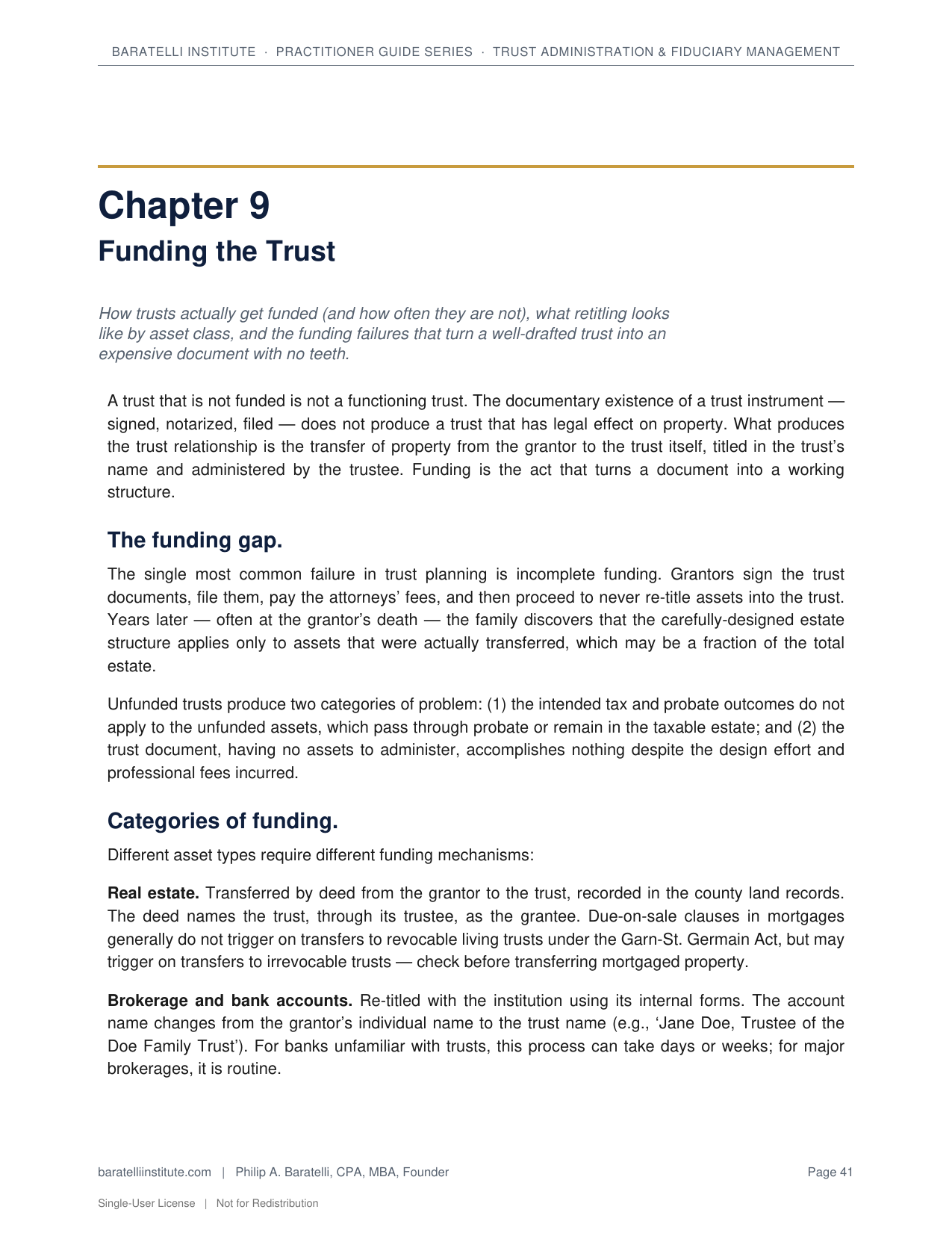
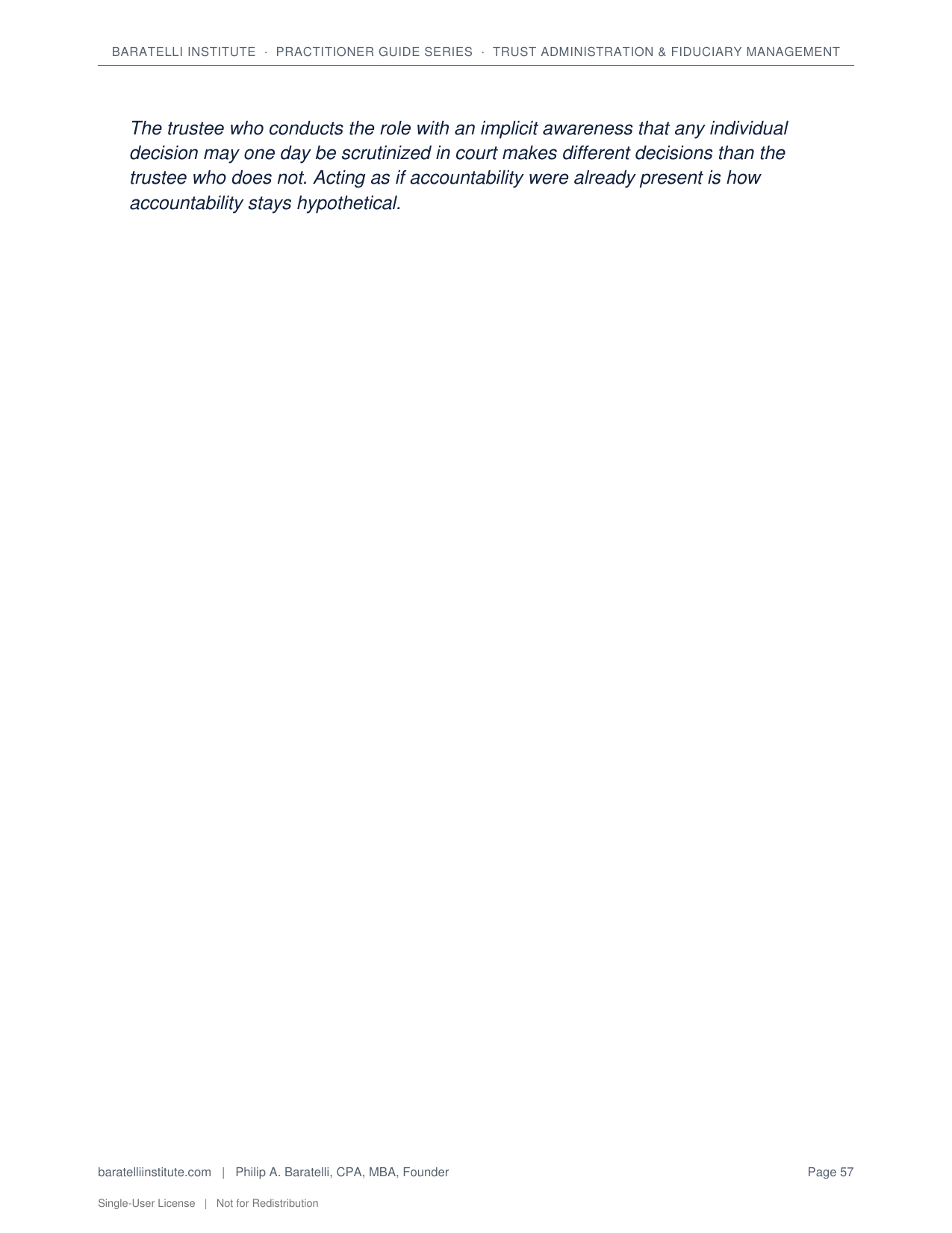
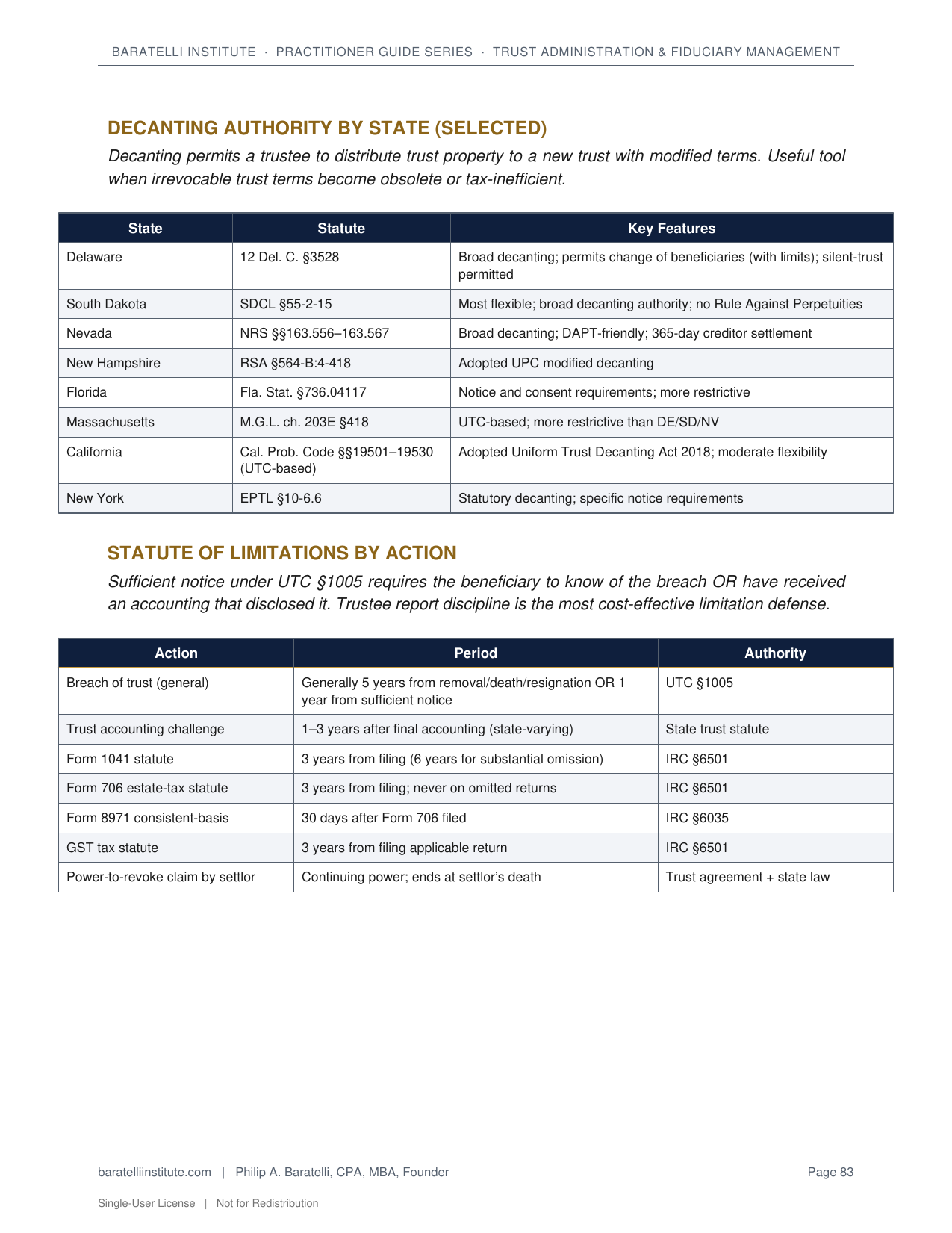
44 chapters (252 pages) across 6 parts + appendices including the 50-state trust modernization scorecard and a sample-document pack (Crummey notice, HEMS language, 65-day election, §645 election, IDGT note, decanting petition, beneficiary receipt-and-release, annual accounting format). Built for new-trustee accessibility: the opening reframe is “You’ve just been named trustee. Read this first.” Chapter 17 is the 30/90/365-day playbook. Searchable, hyperlinked TOC and index. AI prompts inline. Single-user license. A complete, practitioner-voiced reference.
28 working tabs — Trust IPS template, distribution-memo generator, DNI calculator, §645 election timing model, throwback-tax estimator, trustee-compensation reasonableness model, Form 1041 reconciliation tracker, plus the additional tabs added in the 2026 build (GST allocation, SLAT independent-trustee log, GRAT annuity scheduler, IDGT installment-note tracker, decanting checklist, 50-state situs scorecard, trustee fee comparables, SECURE 2.0 conduit/accumulation modeler, and more).
The format that defends a discretionary distribution decision in court. Used by professional fiduciaries at the largest trust companies.
Line-by-line walk through Form 1041 with the matched Schedule K-1 — the format the trust CPA wants to see, and the format the trustee can actually understand.
Free interactive tools at tools.baratelliinstitute.com run the math from the guide on your scenario. No purchase required.
The rest of the route compounds on top of the desk reference.
Want every guide always current + the Brief paid layer + Clarus + monthly office hours?
Drop your email and you'll be first in line when the guide ships. launch pricing locks once you're on the list — even if all 50 sell out before you check the launch email.
No charge today. No spam. Unsubscribe anytime.
Estate Planning — Pick the level that fits
Same practitioner voice at every tier — from the free calcs to the flagship reference.
Related free tools
Every one of these is a working calculator or reference — no signup, no gate.
Federal + state estate-tax exposure with lifetime-gift overlay.
Which trust vehicle fits which family and asset-protection goal.
Trust-as-IRA-beneficiary decision under the 10-year rule.
Fiduciary distributable net income and trust accounting income.
Section 663(b) worksheet for post-year-end distributions.
Corporate vs individual trustee cost across asset sizes.
Required minimum distribution schedule for the beneficiary.
Special needs trust funding sized to lifetime-care projections.
Charitable remainder and lead trust cash-flow and tax impact.
Charitable-gift value with basis, holding-period, and DAF overlay.
Closely held business valuation for estate and gift returns.
US-situs estate-tax exposure for non-resident aliens.