 THE BARATELLI INSTITUTE
· Mentoring at Scale
THE BARATELLI INSTITUTE
· Mentoring at Scale
THE BARATELLI INSTITUTE
· Mentoring at Scale
THE BARATELLI INSTITUTE
· Mentoring at Scale
"The practitioner does not think in asset classes. The practitioner thinks in the seat the practitioner occupies and the activity that seat performs."
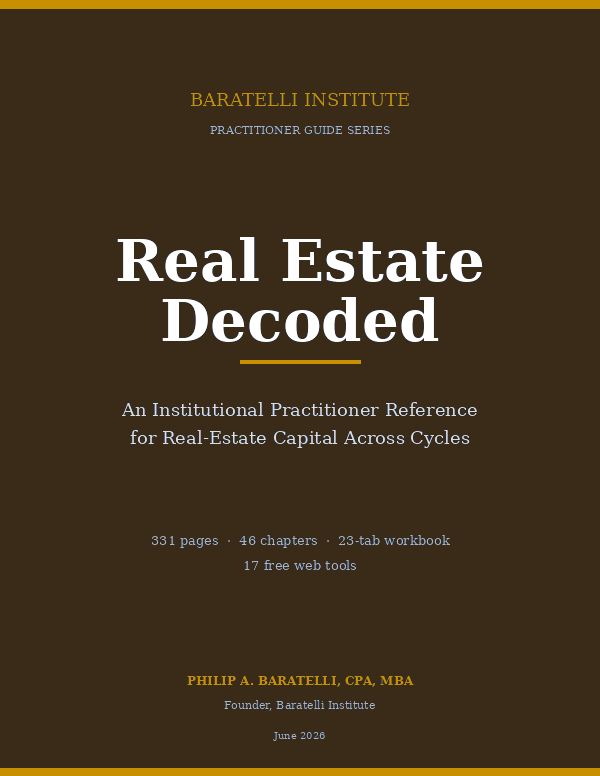
Real-estate capital moves across three practitioner seats — owner-operator, institutional allocator, developer — with a cross-cutting capital-and-brokerage layer connecting them. Most real-estate references organize by property type. This one organizes by the seat the reader occupies. The asset-class material is still here. It is just structured for the practitioner moving capital between residential, commercial, and development positions across cycles. Written at the depth an institutional partner needs and the clarity a first-year analyst can read.
Seventeen interactive calculators paired with the chapters of the guide. Run a real underwriting from your phone right now.
All seventeen tools above are live and free. No email gate. Each runs the math from a chapter of the guide on your own scenario.
Real-estate capital moves across three practitioner seats — owner-operator, institutional allocator, and developer — with a cross-cutting capital-and-brokerage layer that connects them. The persona-routing table below tells you where to start.
| You are… | Start with these chapters |
|---|---|
| Institutional real-estate analyst / associate (years 1-7) PE-real-estate fund, REIT, family office, pension, sovereign wealth, insurance G/A, institutional sponsor | Ch 46 LP Perspective · Ch 38 Capital Stack · Ch 39 Fund Structure · Ch 40 REITs · Ch 45 Cross-Border Capital · Part III (Institutional Track, Chs 14-24) |
| Cottage operator graduating to institutional scale 50-500 doors or 200+ houses; considering syndicating or selling | Part II (Owner-Operator Track, Chs 5-13) · Ch 38 Capital Stack · Ch 42 Investment-Sales Brokerage · Ch 13 Owner-Operator Exit |
| Family-office or RIA real-estate allocator Direct vs. fund vs. REIT exposure mix | Ch 46 LP Perspective · Part III (Institutional Track) · Ch 45 Cross-Border Capital · App K Tax Strategy Quick-Reference · FO Reference Guide cross-references |
| Real-estate developer (residential, mixed-use, mega-project) | Part IV (Developer Track, Chs 25-37) · Ch 36 Construction Lending · Ch 30 Mega-Project Mechanics (incl. failure case) |
| CRE broker — investment-sales, leasing, debt | Part V Chs 42-43 Brokerage · Ch 44 PropTech · Part I Foundations · the Broker Pitch Pack Generator (free tool) |
| CPA / attorney / fractional CFO serving real-estate clients | Ch 11 1031 Exchange · Ch 12 Cost Segregation · Chs 33-35 Entitlement · Ch 45 Cross-Border Capital · App K Tax Strategy · Tax Strategy Decoded cross-references |
| REIT analyst / public real-estate investor | Ch 40 REITs · Ch 16 Multifamily Institutional · Ch 14 Industrial · Ch 17 Hospitality · Ch 21 Data Centers · First Principles cross-references |
| Reading for general practitioner education, no specific deal in view | Part I Foundations · The opening chapter of each subsequent Part · Then chapters that grab your attention |
46 chapters across 5 parts, plus appendices, glossary (157+ terms incl. 17 international-tax terms), and Index of Terms with page references. 28-tab Excel workbook companion. 17 free web tools. 2026 OBBBA Edition - a complete, practitioner-voiced reference.
46 chapters across 5 Parts (Foundations / Owner-Operator / Institutional / Developer / Capital and Brokerage). 17 appendices including sample underwriting walks (SFR, 120-unit MF, 200-key hotel), cap-rate reference tables, cycle indicators, asset-class quick-cards, sample IC memo, common practitioner mistakes, tax-strategy quick reference, cycle history 1975-2025, deal-sourcing playbook, lender-relationships playbook. Glossary with 157+ entries (incl. 17 international tax terms). Index of Terms with page references. Single-user license.
28 tabs. 19 asset-class underwriting models: Multifamily, Industrial, Office, Retail, Hotel, SFR/BTR, Self-Storage, Senior Living, Medical Office, Data Centers, Mixed-Use, Ground-Up Dev, Condo Pre-Sale, NNN, Theme Parks, Land Subdivision, Life Sciences, Cold Storage, EV Charging. Plus Methodology, Glossary, and a cross-asset Returns Comparison tab so the reader can put cap rate, leverage, and hold period on the same screen across every asset class. The same workbook an institutional analyst uses, not a textbook example.
SFR Buy-Box · NNN Cap-Rate Comparer · Multifamily Underwriting · Industrial Cap-Rate · Office Re-Tenanting Cost · RevPAR/ADR Sensitivity · Per-Cap Spend · Senior Living · $/kW/month (Data Centers) · Lot Absorption Schedule · Dev Pro-Forma Builder · Pre-Sale Velocity · Construction Loan Sizer · Capital Stack Visualizer · Broker Pitch Pack Generator · 1031 Exchange · Bonus-Depreciation. Each runs in the browser on your scenario. Each pairs with a workbook tab and a chapter.
Every chapter ends with a Companion block that names its workbook tab and web tool. A System-at-a-Glance front-matter map shows the chapter / workbook / tool wiring at a glance. The three-asset architecture is integrated, not bolted together.
Cross-references to Tax Strategy Decoded (1031, cost seg, intl tax), PE Guide (take-private mechanics), CFO Guide (real-estate-operating-company CFO seat), IRA (insurance + risk architecture for the portfolio), EPD + Trust Admin (estate treatment of a real-estate portfolio), Liquidity Event Playbook (owner-operator portfolio sale), AI Integration Decoded (AI tooling for the practitioner), and Cross-Border Wealth Playbook (international structures). The library is built to compose on the shelf.
The rest of the route compounds on top of the desk reference.
Want every guide always current + the Brief paid layer + monthly office hours? See the Practitioner subscription ($649/yr Founding) →
Seventeen free tools at tools.baratelliinstitute.com run the math from the guide on your scenario. No purchase required. The buy-box, DSCR, 1031, and cap-rate tools are the four most-used by readers.
Real Estate — Pick the level that fits
Same practitioner voice at every tier — from the free calcs to the flagship reference.
Related free tools
Every one of these is a working calculator or reference — no signup, no gate.
Amortization + payoff scenarios across rate + prepay assumptions.
Buyer + seller closing-cost estimator across states.
Metro-to-metro cost-of-living and tax comparison.
DTI, LTV, and reserve tests as underwriters actually run them.
Renovation cost estimator with contingency and time-cost sensitivity.
Bathroom-remodel cost and recovered-value ROI at sale.
Rent vs own vs relocate storage decision framework.
Full first-time-buyer workflow from search to closing.
Full seller workflow from prep to net-proceeds check.
Move-up buyer workflow with bridge-financing scenarios.