 THE BARATELLI INSTITUTE
· Mentoring at Scale
THE BARATELLI INSTITUTE
· Mentoring at Scale
THE BARATELLI INSTITUTE
· Mentoring at Scale
THE BARATELLI INSTITUTE
· Mentoring at Scale
"I used to joke that other companies had floors of people to do what I handled."
At a Fortune-100 the CFO function lives across a dozen siloed teams — controller, treasurer, capital-markets desk, M&A buy-side accounting, equity-comp administration, derivatives, SEC reporting, insurance program, ERP, FP&A. At a mid-cap public company the same functions sit on one desk. This is the reference written from that desk. Close calendars, three-statement modeling at PE-grade depth, capital allocation, working-capital management, debt covenants, derivatives execution, SEC comment-letter response, synthetic-lease structuring, the §382 NOL math, ASC 718 stock comp, treasury & banking, audit prep, ERP/tech stack, AI integration, and the people-side topics (hiring, comp, board management, CEO partnership) that don't appear in textbooks.
The opening chapter of the guide — the week-by-week playbook for the CFO who just walked through the door. What to look at first, who to talk to, what to fix before month-end close, and the discipline that decides whether the rest of the tenure runs smoothly. The honest version, not the seminar version.
13 pages · PDF. No email required.
↓ Download the free PDFWritten for the working CFO and the people they collaborate with. Each chapter has practitioner depth on the technical side and frank handling of the people-side topics other CFO books skip. The persona-routing table below tells you where to start.
| You are… | Start with these chapters |
|---|---|
| First-time CFO in your first 90 days | Ch 2 The Controller's First 90 Days · Ch 3 The CFO's Relationship Map · Ch 8 The Monthly Close · Ch 29 Cash & Treasury Management · Ch 30 Debt, Covenants & Banking |
| Sitting CFO at $5M-$50M company | Ch 10 Budgeting & Forecasting · Ch 13 EBITDA & Adjusted EBITDA · Ch 34 Capital Allocation Framework · Ch 39 AI in the Finance Function · Ch 40 Systems & Technology |
| Sitting CFO at $50M-$500M company | Ch 7 Internal Controls & Audit Readiness · Ch 11 Public Company Reporting · Ch 32 PE-Backed CFO: Sponsor Reporting & Add-Ons · Ch 33 Earnings Quality & Investor Relations · Ch 36 M&A Negotiation Playbook |
| Fractional CFO building a practice | Ch 1 Building the Finance Function from the Inside Out · Ch 9 Financial Reporting (use as client deliverable template) · Apx C AI Prompts Catalog · cfo-engagement.html (engagement profitability tool) |
| Controller targeting CFO | Read front-to-back. The accounting and close chapters (7-31) are the controller's strong suit; the strategic chapters (32-38) are the gap. |
| PE operating partner evaluating CFOs | Ch 32 PE-Backed CFO: Sponsor Reporting & Add-Ons · Ch 13 EBITDA & Adjusted EBITDA · Ch 33 Earnings Quality & Investor Relations (the rubric for what good looks like) |
| CEO hiring a CFO | Ch 3 The CFO's Relationship Map · Ch 4 Finance as a Business Partner · Ch 2 The Controller's First 90 Days (so you know what to expect) |
41 chapters plus six appendices, including the Glossary of Acronyms and Key Terms, the Journal Entry Quick Reference, the AI Prompts Catalog, and the Index of Terms. Page numbers refer to the 494-page PDF.
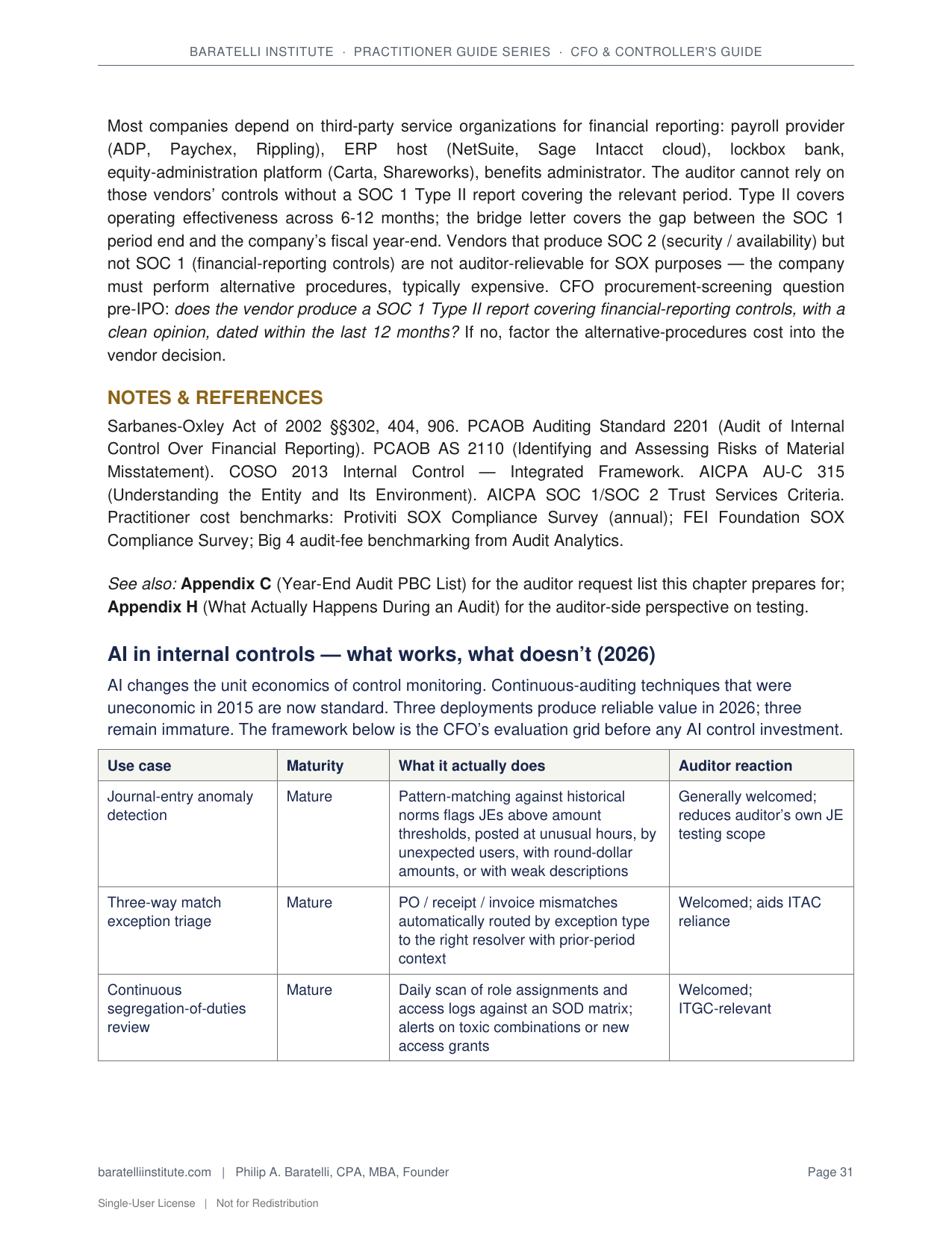
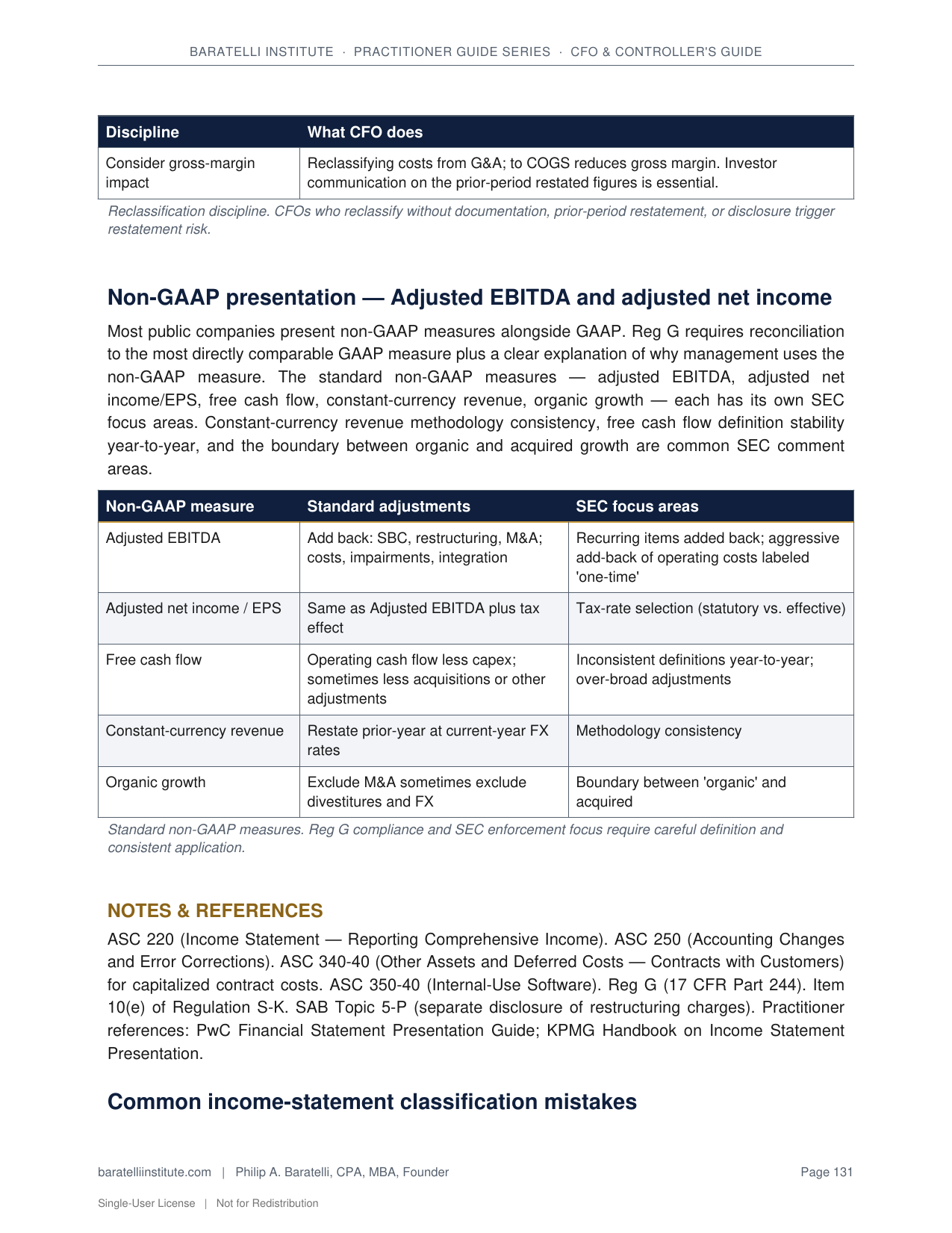
14 sample pages from the actual guide — cover, table of contents, persona routing, sample chapter openers, AI prompt examples, and back matter. These are the actual pages that ship; not marketing renders.
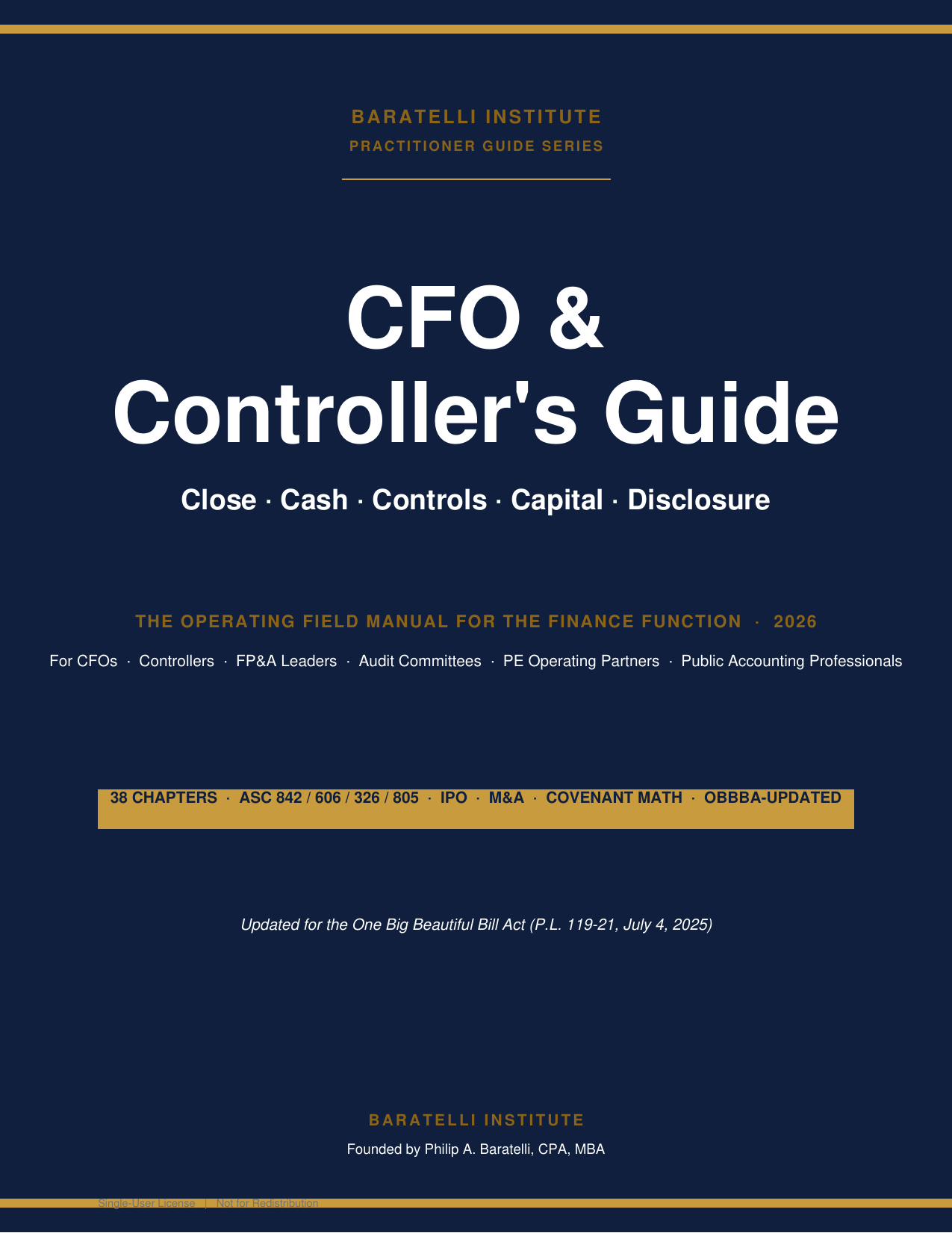
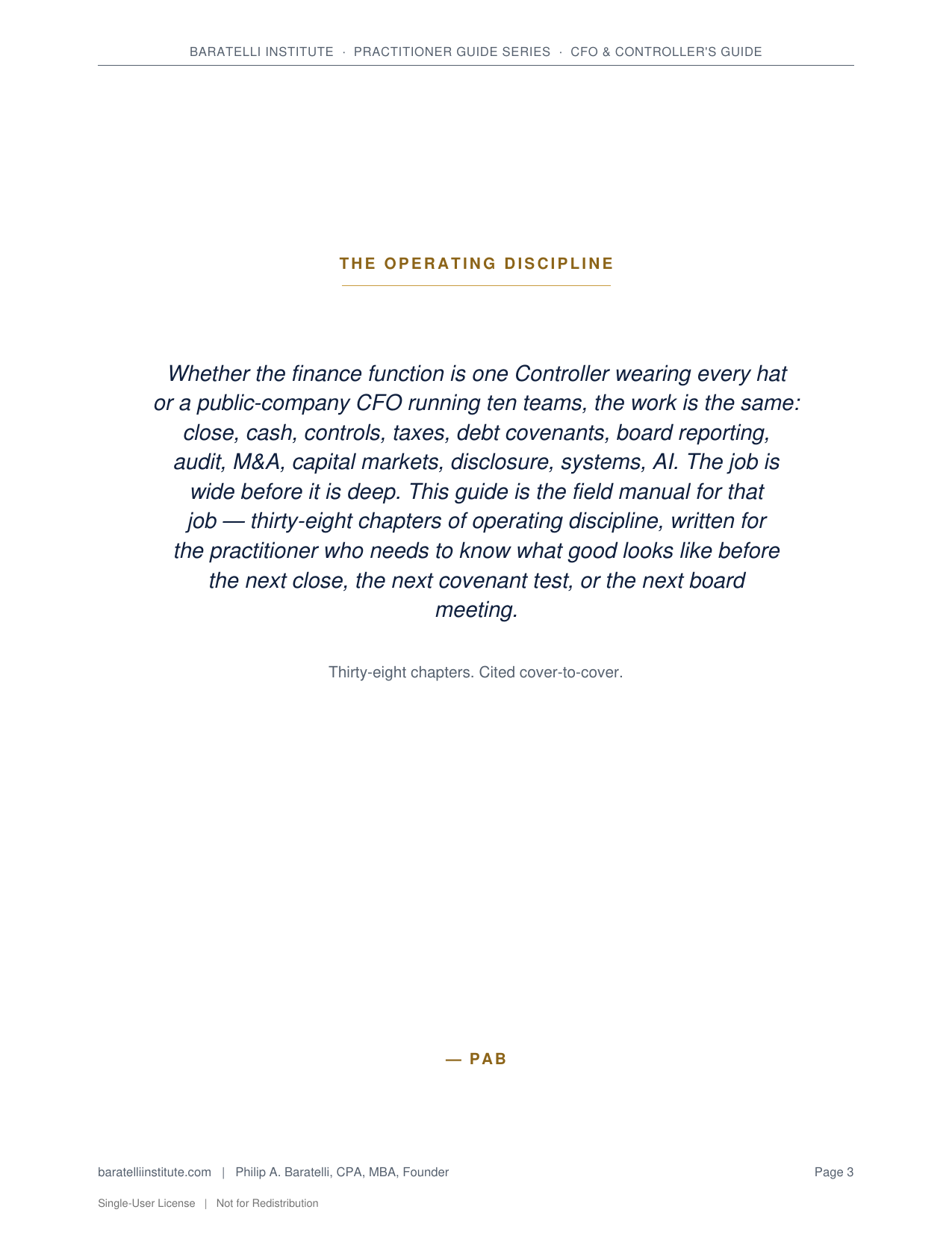
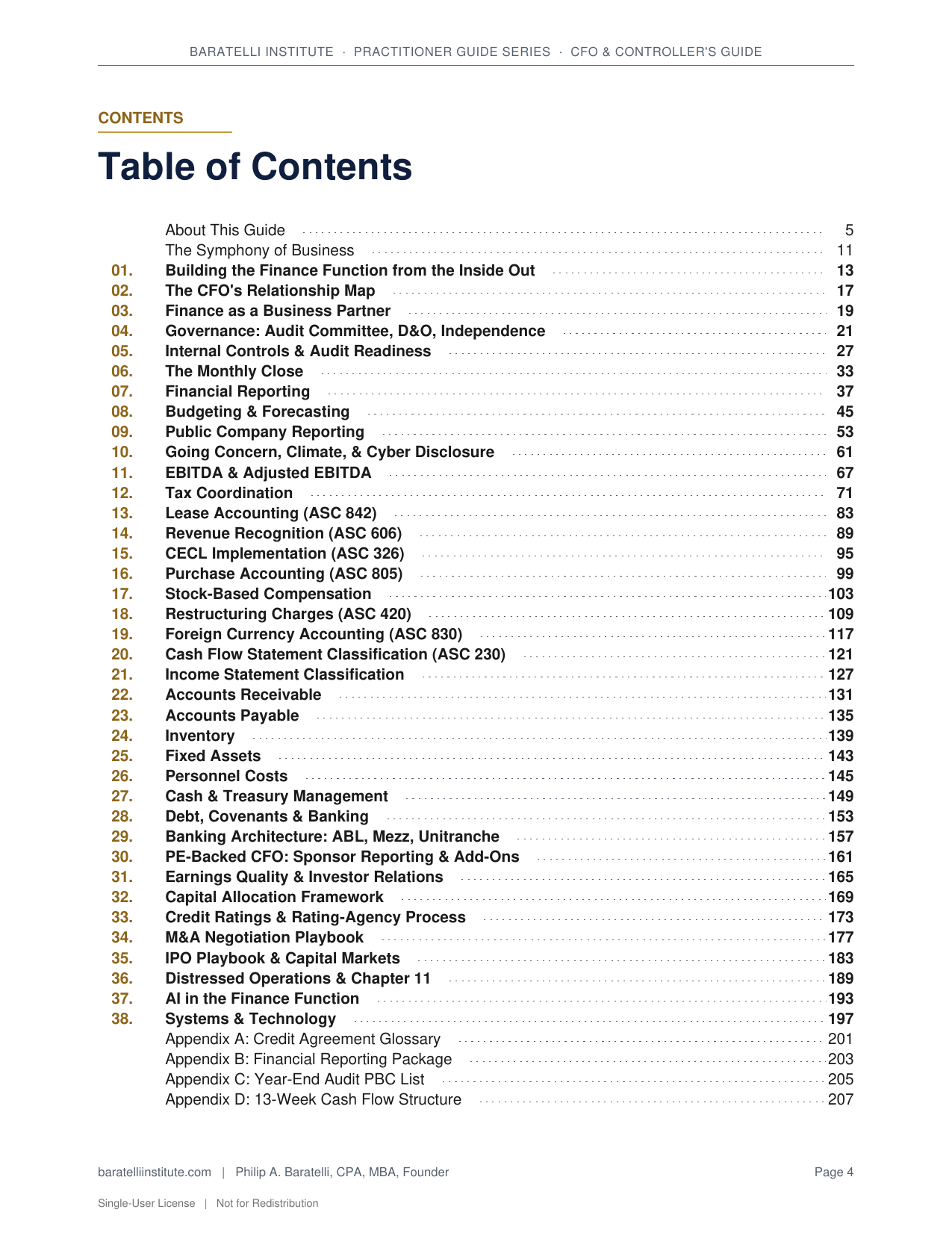
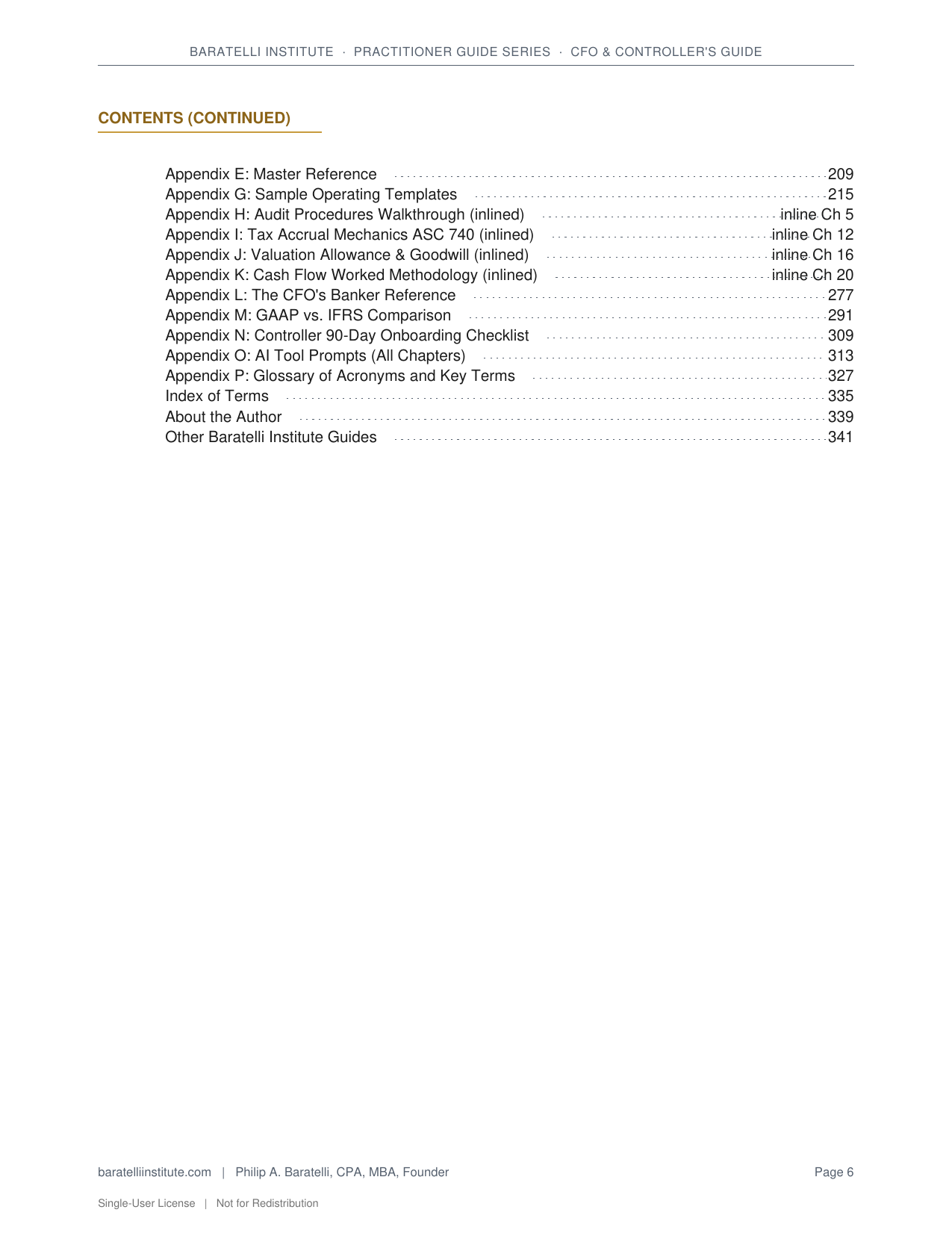
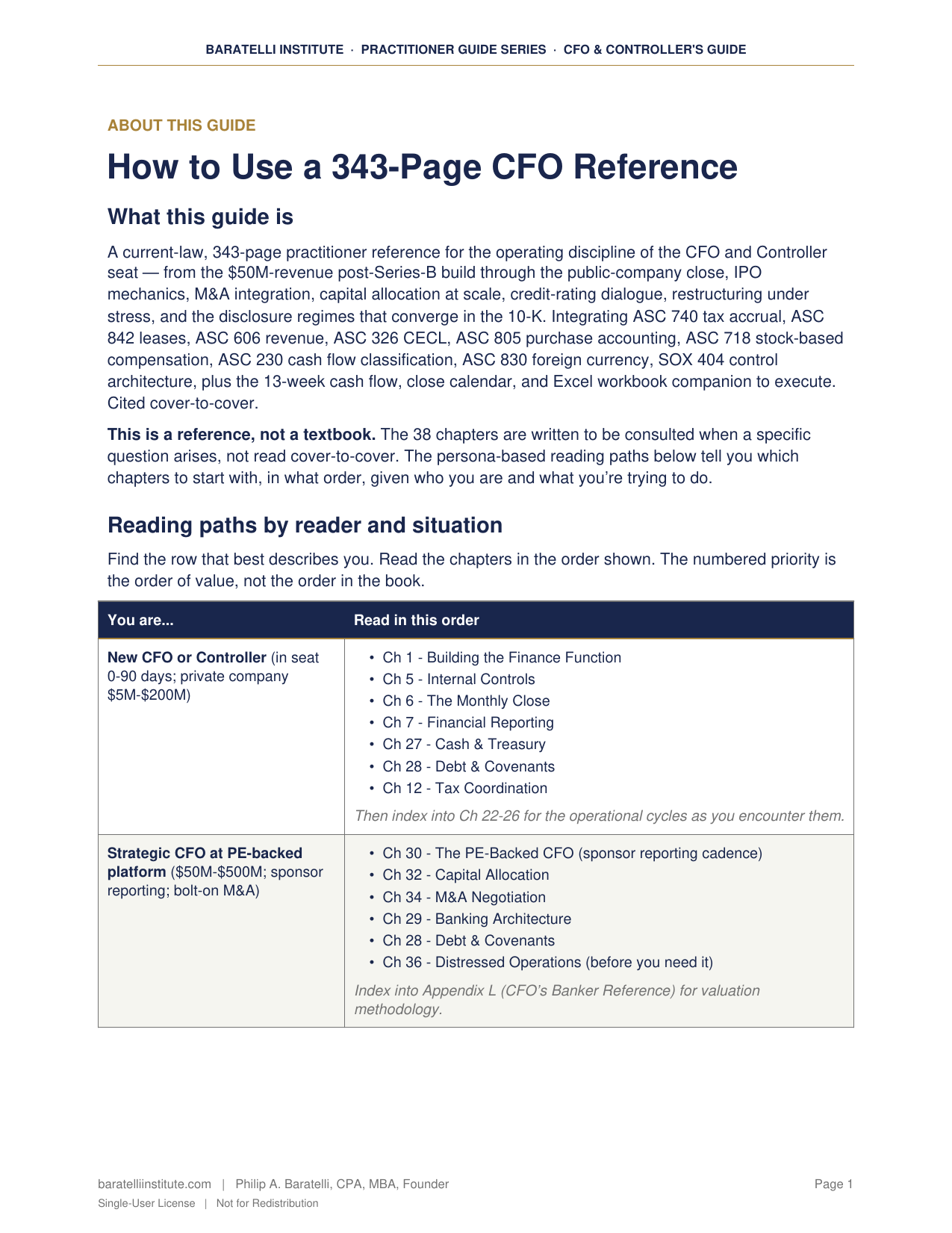
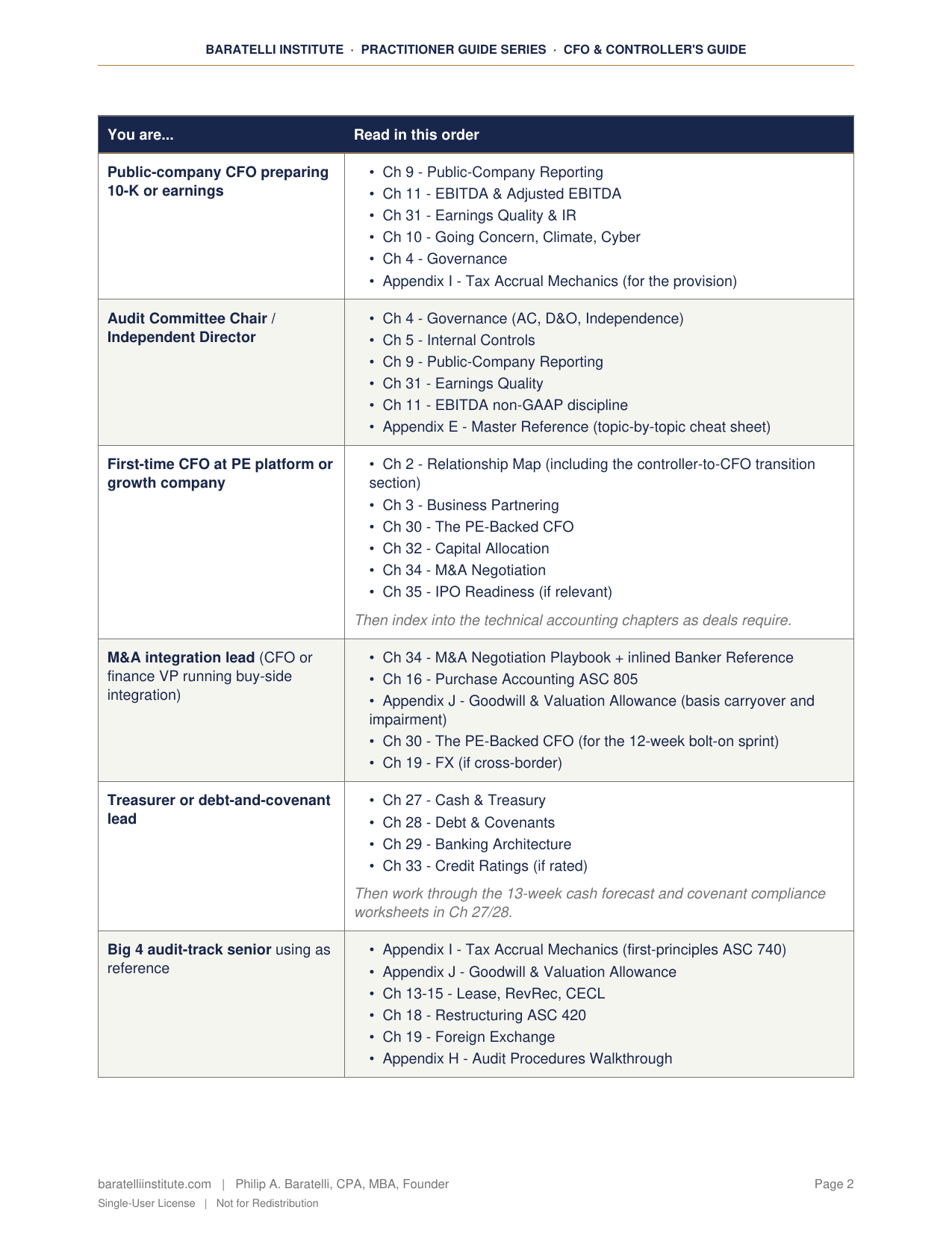
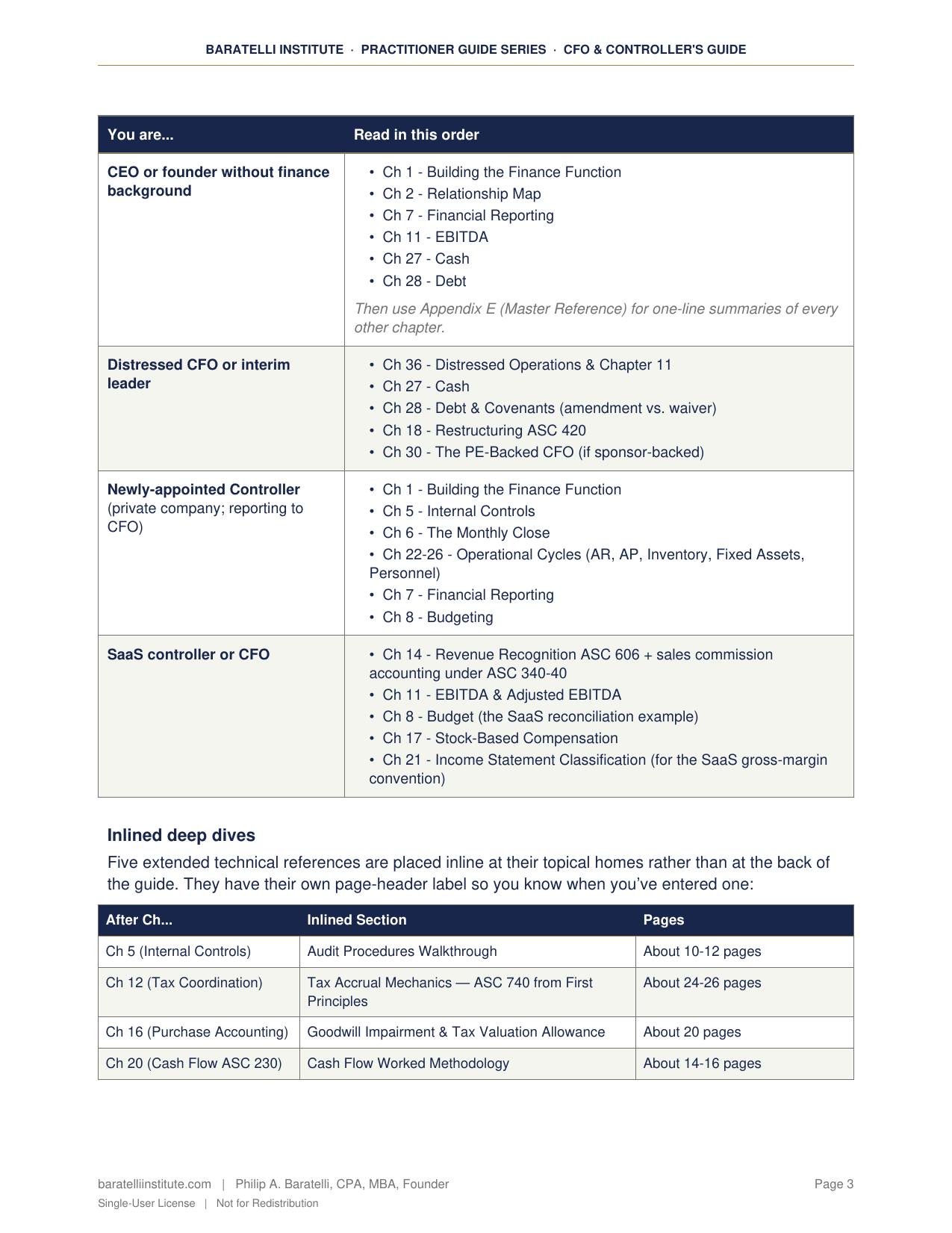
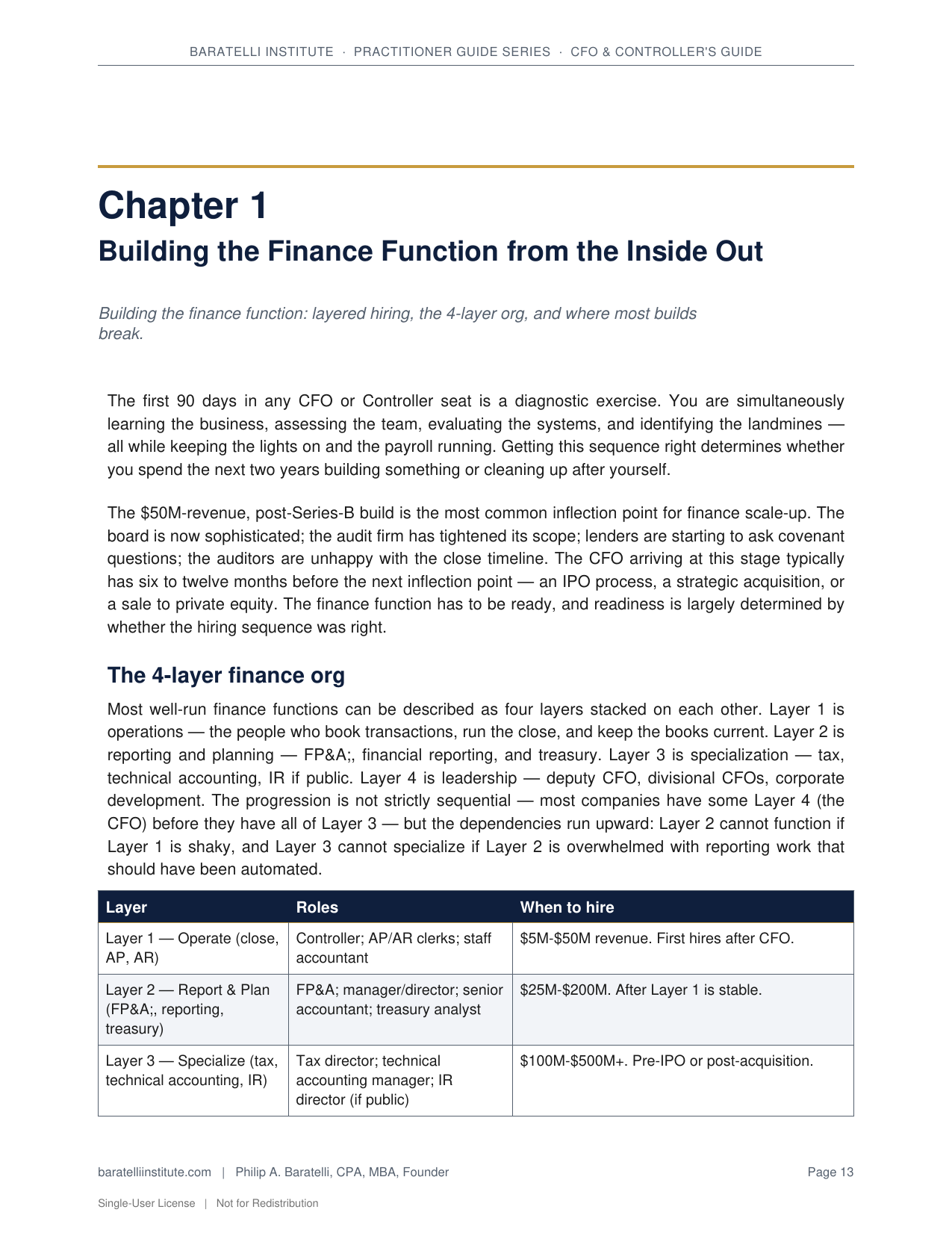
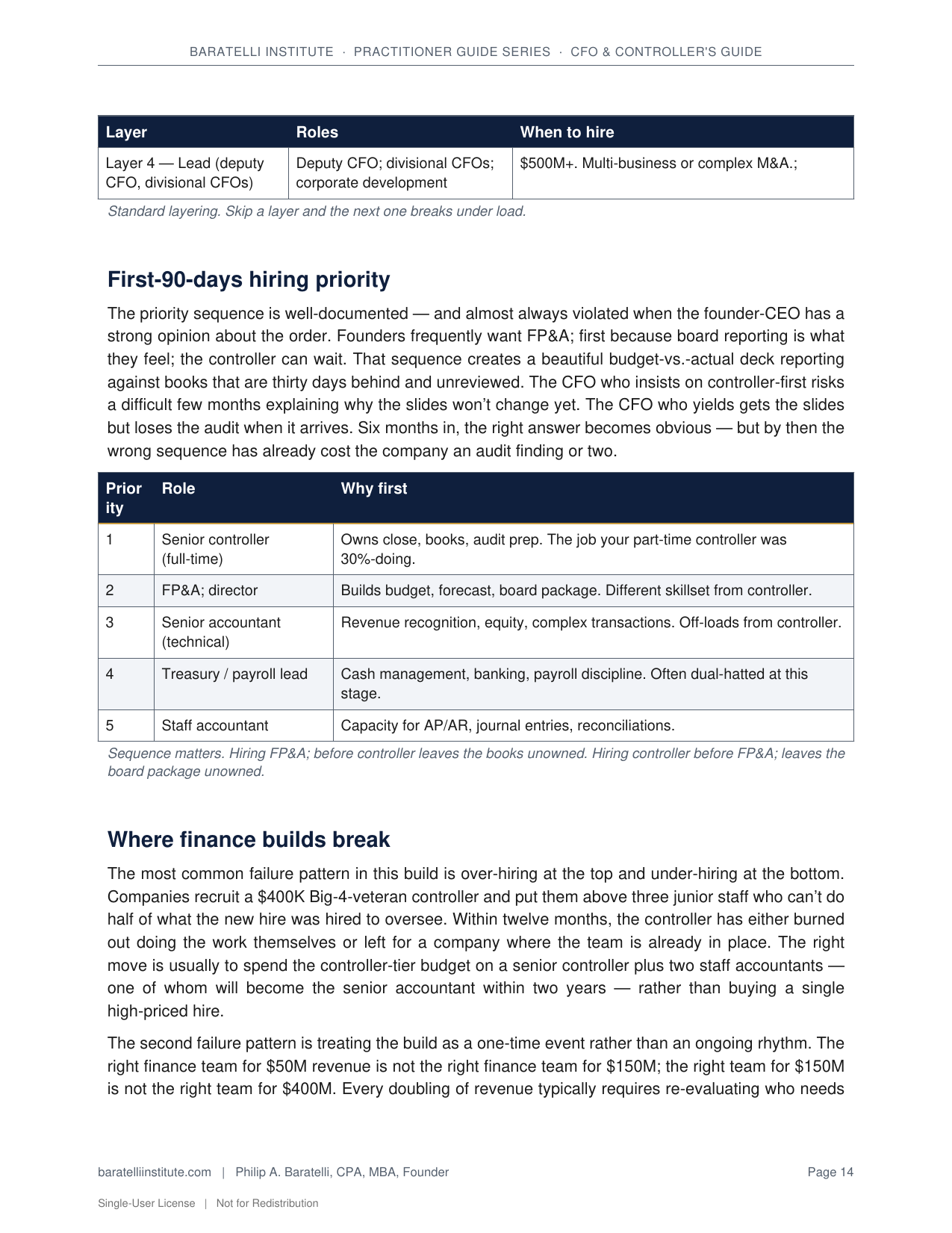
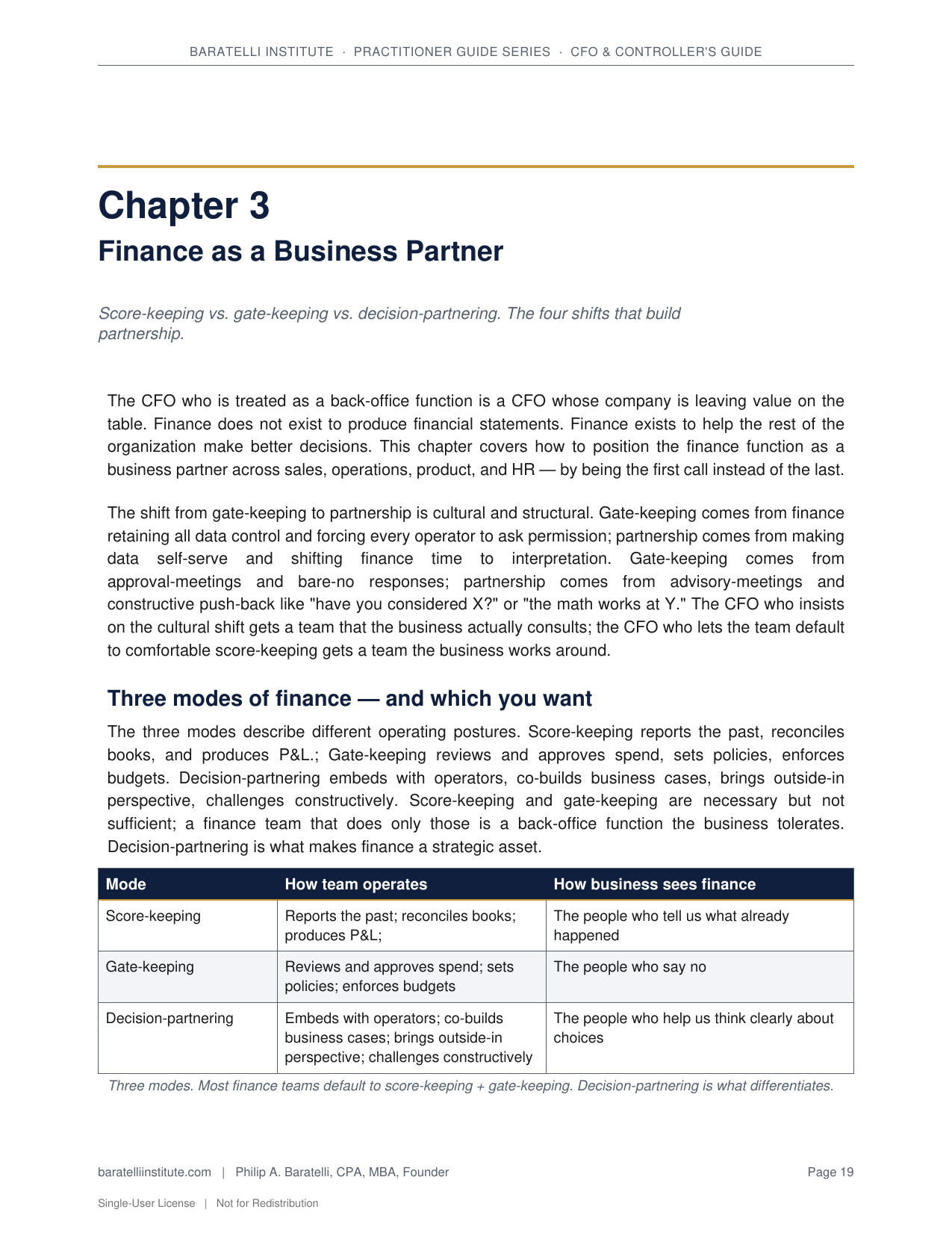
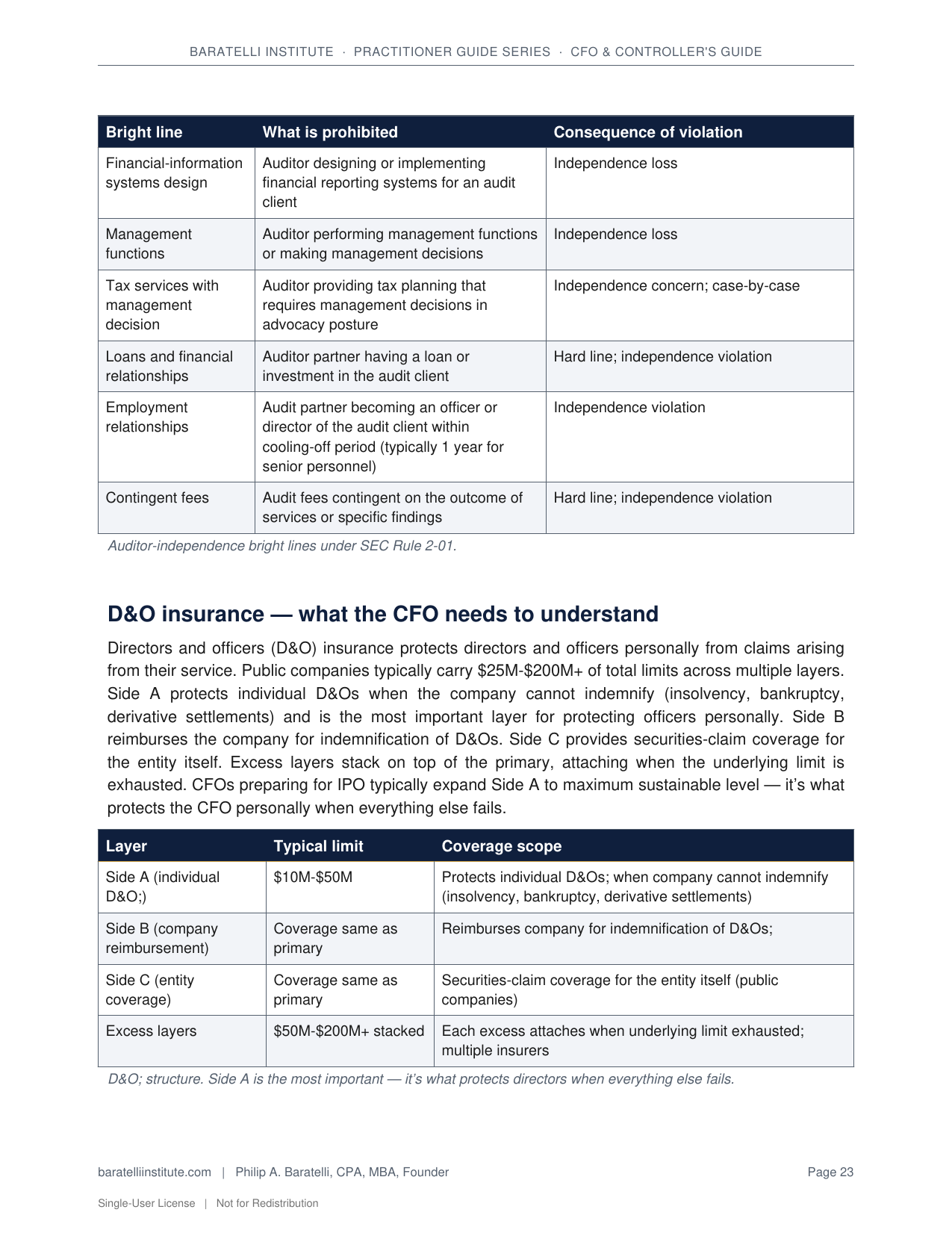

41 chapters + 6 appendices. Searchable, hyperlinked TOC and index. AI prompts inline at section boundaries in 16 chapters, consolidated in the Appendix C AI Prompts Catalog. Single-user license for one practitioner.
The actual templates a sitting CFO uses — three-statement model with formula-driven tie-outs, 13-week cash flow forecast, 5-year operating LRP, monthly reporting pack, KPI dashboard, vendor scorecard, cyber scorecard, AI readiness scorecard, CapEx justification template with NPV / IRR / payback. The same workbook the partner uses, not a textbook example.
120+ practitioner-grade prompts for Claude, ChatGPT, and Gemini. Each prompt is field-tested for finance use cases — board memo drafting, variance analysis writeup, lender covenant compliance memos, M&A working-capital normalization, year-end audit prep questions, ASC 606 revenue recognition fact patterns. Use them directly in your AI tool of choice.
Four additional formula-driven workbooks, each self-checking and built to teach the mechanics as you use them. The Subsidiary Reporting Package turns one trial balance into a full IFRS statement set — position, profit or loss, changes in equity, and a fully traced indirect cash flow — with consolidation, IAS 21 FX translation, intercompany, roll-forwards and a tax-data-pack tab. Plus three US-GAAP impairment models, each building the cash flows up line by line: ASC 360 long-lived asset / asset group, ASC 350 goodwill (reporting-unit / subsidiary), and ASC 350-30 indefinite-lived intangible (relief-from-royalty). A built-in decision aid routes you to the right impairment test.
Ten free interactive tools at tools.baratelliinstitute.com run the math from the guide on your scenario. No purchase required.
Five companion calculators for Chapter 19 — the four standard ASC 718 / IFRS 2 valuation models plus Phil's SBC Reality Check framework (not offered by any other public web tool).
The rest of the route compounds on top of the desk reference.
For the professional who runs the close, advises the client, or carries the liability, this isn't priced against other books. It's priced against the cost of the work it replaces — and the upside of a single better decision.
A CFO doesn't price a reference against other books — they price it against the figures on their own statements. Audit fees run into seven figures; the fully-loaded cost of the finance function runs higher still. Shave a few points off the audit with cleaner, audit-ready schedules — trim days off the close and the reporting cycle — sharpen the visibility behind a single capital-allocation decision — and the return isn't a multiple of the price, it's a different order of magnitude. At the scale you operate, this guide is a rounding error against the decisions it improves — for a company, it sits below any approval threshold and is expensed without a second thought.
At the level you work, a single usable insight — one cleaner close, one defensible position — pays the price back many times over. The other several hundred pages are upside.
Price out having your team build and test the ASC 842 lease calculator, the ASC 360 / 350 impairment models, the deferred-tax engine, and the subsidiary reporting pack. A day of analyst time already exceeds the price — and a build-and-validate cycle is weeks, not a day.
The answer a full career arrives at — ready to use, for a fraction of the first hour of the equivalent advisory engagement. And unlike the engagement, it doesn't leave; it's there for the next decision, and the one after that.
Bring one fresh, well-reasoned idea to a client meeting and you've set yourself apart from every peer with last year's advice. A single volume is a year of substantive material — for client conversations and for your own public voice.
And on the downside: one prevented misstep — a missed disclosure, a surcharge, a restatement — covers the price many times over.
These weren't assembled by a content team or handed to a junior associate. They were built by one practitioner — a full career in the work, every hard lesson already paid for — for the professional who needs the right answer now.
— Philip A. Baratelli, CPA, MBA, Founder
The ideas are already on the page. The only thing between you and the first one is the decision to start. Backed by a 30-day money-back guarantee.
A single entry doesn’t produce one number — it produces six, one for each audience that asks. Most references give you only the GAAP figure. This guide reads every significant entry through all six lenses and keeps them reconciled — so you always know which number an audience is hearing, and why two charges that both get “added back” are not the same thing at all.
| Lens — who asks | $4.0M stock comp (non-cash) | $3.0M restructuring (cash) | Comment |
|---|---|---|---|
| US GAAP SEC filings; auditors |
−$4.0M expense (ASC 718) | −$3.0M expense (ASC 420) | Both reduce GAAP operating income and EPS in full. |
| Adjusted EBITDA / EPS The Street (Reg G) |
$0 — added back (non-cash) | $0 — added back (non-recurring) | Both removed — but for opposite reasons. Disclosed and reconciled to GAAP. |
| Tax (IRS) Return & cash taxes |
Deduction decoupled from book — lands at vest/exercise on intrinsic value; ISOs none; §162(m) $1M cap | Fully deductible when incurred — a real cash-tax benefit (~$3.0M × rate) | The trap. Both are “added back,” yet only the cash charge actually cut cash taxes. Adjusted EBITDA treats economic opposites identically. |
| Bank covenant EBITDA Lenders; ratios |
$0 — added back (usually uncapped) | Added back only within the agreement’s capped permitted add-backs | Restructuring add-backs are typically capped; SBC usually isn’t. Read the defined term. |
| Bonus / incentive plan Comp committee |
Typically added back | May be declined — it’s real cash the team spent | Plan-defined. Treating a cash cost like a non-cash one over-pays the pool. |
| International & statutory Local filings, by country |
IFRS 2 / local GAAP differs; intercompany recharge | Expensed in statutory books; local deductibility varies | Both hit the statutory P&L; the cash charge’s local deduction is usually clearer. |
That is why the same charge is fought over from opposite directions — and why one number is never enough. Every major estimate in the guide — the inventory-obsolescence reserve, the AR allowance, the tax valuation allowance, leases — is read through all six lenses, with a companion workbook tab that keeps them reconciled to GAAP. The full method page leads the free preview.