 THE BARATELLI INSTITUTE
· Mentoring at Scale
THE BARATELLI INSTITUTE
· Mentoring at Scale
THE BARATELLI INSTITUTE
· Mentoring at Scale
THE BARATELLI INSTITUTE
· Mentoring at Scale
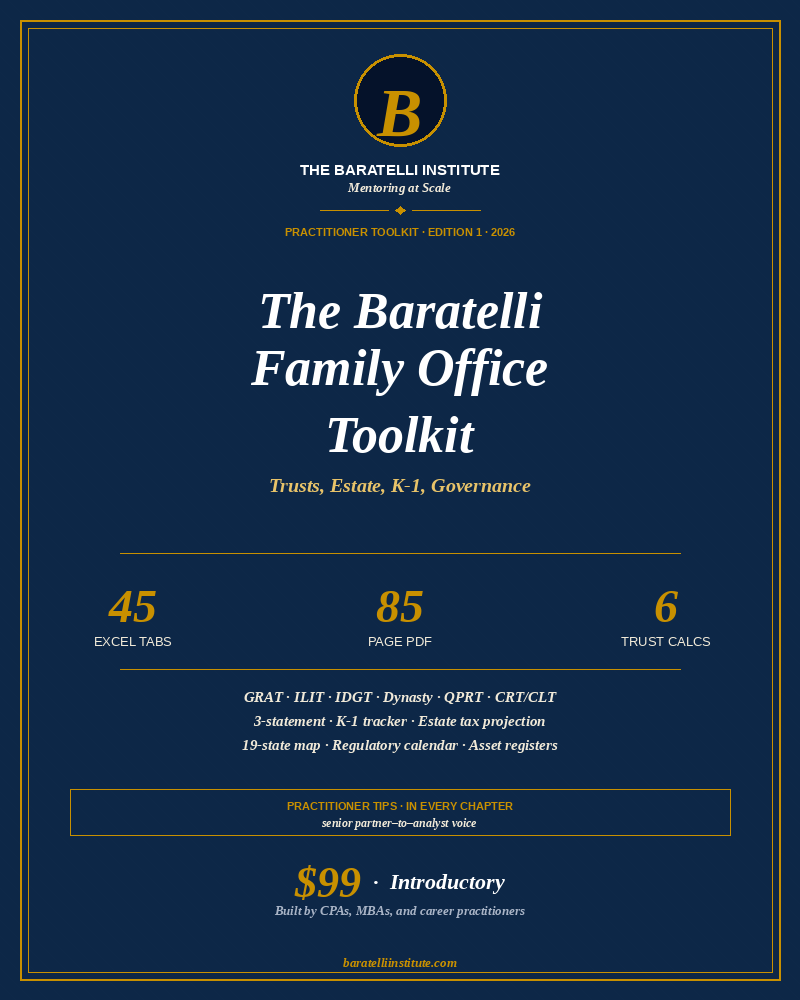
The 3-workbook bundle for practitioners running family-office CFO work. GRAT, ILIT, IDGT, Dynasty, QPRT, and CRT/CLT trust calculators; consolidated 3-statement financials across entities; K-1 basis/at-risk/PAL tracking; 27-filing regulatory calendar; 10-register asset tracker (real estate, art, jewelry, wine, watches, automobiles, aircraft, insurance, other); governance templates for AI readiness, cyber, vendor and staff scorecards. 45 tabs, three thematic workbooks, 85-page methodology PDF with Practitioner Tips in every one of 15 chapters.
Print-ready formatting. Compatible with Excel, Google Sheets, and Numbers.
Family Office · Pick the level that fits
Same practitioner voice at every tier — from the free cost estimator to the 488-page reference.
Related free tools & calculators
Every one of these is a working calculator or reference — no signup, no gate.
Instant SFO vs. MFO vs. fractional cost model with staffing scenarios.
Special needs trust funding sized to lifetime-care projections.
How ABLE accounts and third-party SNTs stack under Medicaid rules.
Asset-limit and income-cliff modeling for waiver-eligibility planning.
Itemized medical deduction sizing with AGI-floor sensitivity.
Required minimum distribution schedule under current law.
Claiming-age optimization across single, spousal, and survivor filings.
Corporate vs. individual trustee cost across asset sizes and complexity.
Trust-as-IRA-beneficiary decision tool for the 10-year-payout rules.
Fiduciary distributable net income and trust accounting income walk.
Section 663(b) worksheet for post-year-end fiduciary distributions.
Excess-liability coverage sized to household net worth and asset mix.
529 plan sizing with the SECURE 2.0 Roth-rollover overlay.
Composite readiness score across savings, income, and longevity.
Three thematic Excel workbooks, forty-five tabs in total, each formatted to a practitioner-grade convention: blue for inputs, black for calculations, green for cross-sheet links, red for check figures, gold-shaded for key outputs. Every tab is print-ready with landscape page setup on wide tables, print titles that repeat headers, freeze panes, and a Baratelli brand strip footer.
The companion methodology document walks through the calculations tab-by-tab across 15 chapters — what each model is for, the line-by-line mechanics, common pitfalls, and the family-office context (who signs, who reviews, how it hits the K-1). Case-anchored to the Baratelli Institute's Belron, Comcast, LVMH, and Samsung case studies where relevant.
Every one of the 15 methodology chapters closes with a Practitioner Tip callout — senior-partner-to-analyst voice, teaching what to do with the model's output, not just how to build it.
Any planning book will teach you how to construct a GRAT, an ILIT, an IDGT sale. Almost none teach you what happens next — what a senior partner asks in the annual review, which assumptions actually move the transfer-tax answer, how to communicate to a founder or a next-gen board, when to trust the output and when to override it. That interpretation layer is the difference between a technician who can populate cells and a practitioner who can advise.
You got a zeroed-out gift with a $12M projected remainder. Compare to rolling-GRAT ladder alternative. Which assumption moves the answer most (asset return above 7520 rate). When to trust it, when to stack multiple short-term GRATs instead.
You got a $40M transfer at 9% AFR. What the "grantor tax burn" really costs on cash flow. When the sale beats a straight GRAT. How to explain the seed-gift ratio to a founder who's never heard of it.
You allocated $14M GST exemption for a projected multi-generation NPV. Which states allow perpetuities. When to layer in decanting flexibility. What a next-gen review committee will actually ask.
You showed $8M projected state estate tax in Massachusetts. Cliff vs. exemption structures matter. When domicile change actually saves the money. How to model portability for the surviving spouse.
You caught a $2.3M PAL suspended loss the prior CPA missed. Why basis and at-risk are different and when it matters. How to communicate to the family that a "loss" on the K-1 may be usable this year.
All 15 chapters — from GRAT and ILIT through K-1, regulatory calendar, and governance — carry a Practitioner Tip. Interpretation, communication, senior-partner catches, common committee questions.
The Practitioner Tips are the feature that turns the Toolkit from a template package into a decision-support reference. They're the reason to buy this over any collection of trust calculators you could assemble yourself.
The Toolkit and the Family Office Reference Guide are designed to work together. Buy the Toolkit if you need working templates today. Buy the Guide if you need the practitioner reference behind them. Buy both if you're running a real seat.
45 working Excel tabs plus 85-page methodology PDF. What you do.
What the Guide adds on top of the Toolkit. What you know.
See the Guide at /guide-fo ($199). Toolkit + Guide bundle discount available at checkout.
The Toolkit is available under four licenses. Every tier includes the full 45-tab bundle across three workbooks and the 85-page methodology PDF. Enterprise SKUs (10-seat and above) add quarterly rate updates and priority support.
| Tier | Price | Best for | Includes |
|---|---|---|---|
| Personal | $99 | Solo practitioner, one-family office | Full toolkit, personal use license |
| Firm 10-seat | $299 | Small CPA / law firm, boutique RIA | 10 named users, quarterly update rights |
| Firm 25-seat | $599 | Mid-size firm, growing MFO | 25 named users, quarterly updates, priority email support |
| Firm Unlimited | $1,499 | Large firm / enterprise — see license terms ↓ | Unlimited users at one firm, quarterly updates, priority support, white-label rights |
Enterprise SKUs include quarterly rate updates (§7520, AFR, state estate tax thresholds) and are licensed per-firm. Contact philbaratelli@gmail.com for enterprise onboarding.
What each of the four tiers actually covers — twelve policy dimensions spelled out in plain English so a CPA firm's managing partner, a general counsel, or a COO can size the license against firm need before purchase.
| Policy dimension | Personal — $99 | Firm 10-seat — $299 | Firm 25-seat — $599 | Firm Unlimited — $1,499 |
|---|---|---|---|---|
| 1. Number of named users | 1 named user | 10 named users | 25 named users | Unlimited users at ONE firm (single legal entity) |
| 2. User type restriction | Individual practitioner | Employees + contractors of the licensed firm ONLY; not for consultants or clients of the firm | Employees + contractors of the licensed firm ONLY; not for consultants or clients of the firm | Employees + contractors of the licensed firm ONLY; not for consultants or clients of the firm |
| 3. License term | Perpetual for Edition 1 + free updates through Edition 2 | Annual license, auto-renew; includes all edition updates within the term | Annual license, auto-renew; includes all edition updates within the term | Annual license, auto-renew; includes all edition updates within the term |
| 4. Update rights | Free updates through Edition 2 (planned 2027) | All edition updates within the paid term + quarterly rate updates (§7520, AFR, state estate tax thresholds) | All edition updates within the paid term + quarterly rate updates (§7520, AFR, state estate tax thresholds) | All edition updates within the paid term + quarterly rate updates (§7520, AFR, state estate tax thresholds) |
| 5. White-label rights | No | No | Light co-brand — may add firm logo to landing tab | Full white-label rights to remove Baratelli branding for internal use ONLY. External distribution to clients or third parties still requires attribution. |
| 6. Support tier | Email support, 5-business-day SLA | Email support, 3-day SLA + quarterly office-hours webinar access | Email support, 3-day SLA + quarterly office-hours webinar access + priority email 1-day SLA | All of the above + dedicated support contact + implementation call |
| 7. Redistribution | Cannot resell, sublicense, or make workbook/PDF public | Cannot resell, sublicense, or make workbook/PDF public. May install on any number of firm-owned devices. | Cannot resell, sublicense, or make workbook/PDF public. May install on any number of firm-owned devices. | Cannot resell, sublicense, or make workbook/PDF public. May install on any number of firm-owned devices. |
| 8. Client work | Content may be used to serve clients (clients benefit from the practitioner using the toolkit). Toolkit files themselves may NOT be handed to clients — the licensee retains and uses them. | Content may be used to serve clients. Toolkit files themselves may NOT be handed to clients — the firm retains and uses them. | Content may be used to serve clients. Toolkit files themselves may NOT be handed to clients — the firm retains and uses them. | Content may be used to serve clients. Toolkit files themselves may NOT be handed to clients — the firm retains and uses them. |
| 9. Training use | Personal study only | May be used in internal firm training | May be used in internal firm training | Internal firm training + university / CPE cohort training with attribution |
| 10. Cancellation | Perpetual — no cancellation applies | Annual; cancel at any time; no refund of prepaid term | Annual; cancel at any time; no refund of prepaid term | Annual; cancel at any time; no refund of prepaid term |
| 11. Enterprise onboarding | Self-serve via Gumroad | Enterprise contract via philbaratelli@gmail.com; invoice payable via ACH or wire (Gumroad optional for cards) | Enterprise contract via philbaratelli@gmail.com; invoice payable via ACH or wire (Gumroad optional for cards) | Enterprise contract via philbaratelli@gmail.com; invoice payable via ACH or wire (Gumroad optional for cards) |
| 12. Effective date + governing law | Effective at purchase. Governed by Florida law. Disputes resolved in Duval County, Florida. | Effective at purchase. Governed by Florida law. Disputes resolved in Duval County, Florida. | Effective at purchase. Governed by Florida law. Disputes resolved in Duval County, Florida. | Effective at purchase. Governed by Florida law. Disputes resolved in Duval County, Florida. |
Footnote. Firm license terms are non-negotiable at the $299 and $599 tiers.