 THE BARATELLI INSTITUTE
· Mentoring at Scale
THE BARATELLI INSTITUTE
· Mentoring at Scale
THE BARATELLI INSTITUTE
· Mentoring at Scale
THE BARATELLI INSTITUTE
· Mentoring at Scale
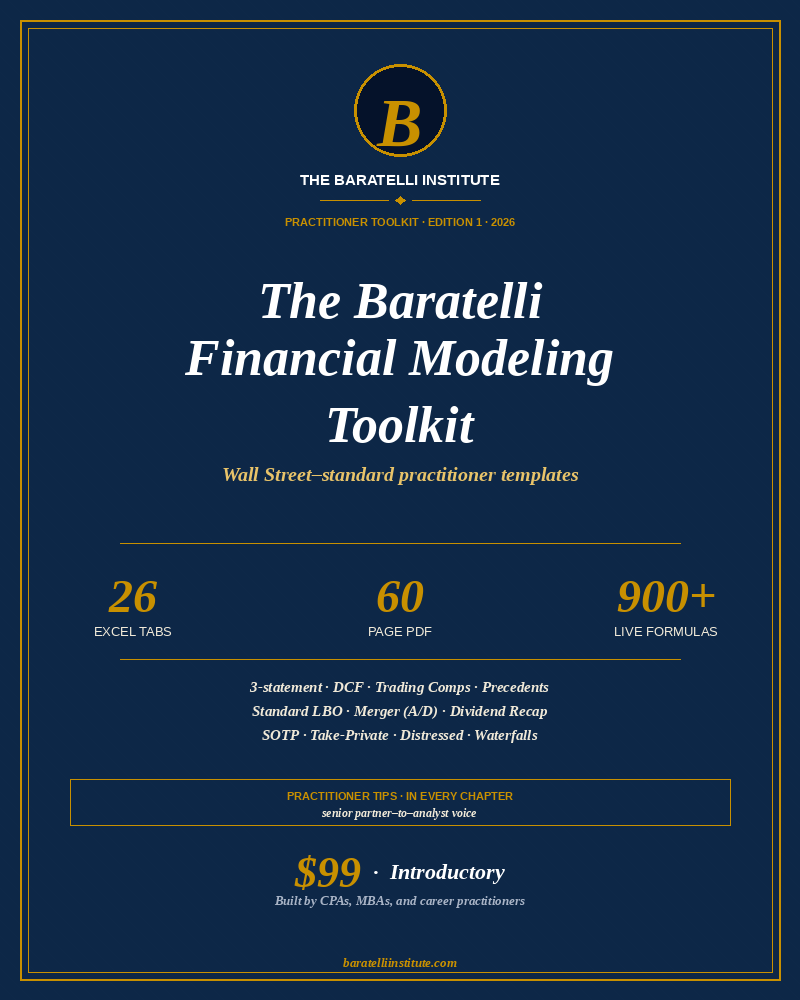
Wall Street–standard templates for practitioners. Twenty-six rigorously formatted Excel tabs — DCF, LBO, Merger (accretion / dilution), Trading Comps, Precedent Transactions, Football Field, WACC, SOTP, Dividend Recap, Roll-Up, Take-Private, Distressed, Fund Waterfall, Return Attribution, Sensitivity, and a full 6-tab integrated 3-statement model — plus a 60-page methodology PDF explaining each model's use, line-by-line walkthrough, common pitfalls, and Practitioner Tips in every chapter: senior-partner-to-analyst voice teaching what to do with the model's output, not just how to build it. Every tab: color-coded to Wall Street convention, print-ready page setup, freeze panes, headers and footers, check figures in red, key outputs shaded gold.
Print-ready formatting. Compatible with Excel, Google Sheets, and Numbers.
Financial Modeling & M&A · Pick the level that fits
Same practitioner voice at every tier — from the free acquisition records to the 800-page CFO reference.
Related free tools & libraries
Every one of these is a working calculator or reference — no signup, no gate.
Interactive weighted-average cost-of-capital calc with the Baratelli methodology.
73 company references plus the full methodology. Refreshed quarterly.
YTM, YTC, current yield — the fixed-income back-solve.
Macaulay, modified, and effective duration plus convexity adjustment.
Rolling maturity structure with cash-flow, yield, and duration outputs.
Tax-equivalent yield and after-tax comparison for muni holdings.
Sponsor-return math on a leverage-funded distribution.
Stock-based comp valuation via the closed-form Black-Scholes.
Discrete-time lattice for exotic vesting and early-exercise features.
Simulation-based value for TSR-linked performance awards.
Multi-period reinvestment and yield-on-cost across scenarios.
Full library — Apple to Nestle to Reliance. Snapshot inputs sourced to filings.
Berkshire, Danaher, Constellation, Blackstone, Apollo, LVMH, and 37 more.
Board-grade practitioner memos — LVMH, SpaceX, Dell, Disney, Belron.
One-page cheat sheet — formulas, conventions, sensitivity rules.
Every tab in the workbook follows the industry-standard color-coding convention — blue for inputs, black for calculations, green for cross-sheet links, red for check figures, gold-shaded for key outputs. Every tab is print-ready: landscape page setup on wide tables, print areas explicitly set, print titles that repeat headers on every printed page, freeze panes so labels stay visible while scrolling, and headers and footers with page numbering and Baratelli brand strip.
A companion methodology document that walks through each of the seventeen models: what the model is for, line-by-line walkthrough, when to use it and when not to, common pitfalls, and typical M&A interview questions the model answers. Includes case-study anchors to the Baratelli Institute Belron, Danaher, Comcast, LVMH, Samsung, and Penske / Berkshire case studies.
Every methodology chapter closes with a Practitioner Tips callout — senior-partner-to-analyst voice, teaching what to do with the model's output, not just how to build it.
Any modeling book will teach you how to construct a DCF, an LBO, a merger model. Almost none teach you what happens next — what a senior MD asks in the review, which assumptions actually move the answer, how to communicate to a Board, when to trust the output and when to override it. That interpretation layer is the difference between an analyst who can build and a practitioner who can decide.
You got a share price of $X. Compare to market. Which assumptions move the answer most (typically WACC + terminal growth = 60-70% of DCF variability). When to trust it, when to override.
You got 22% IRR. Compare to fund hurdle. What tuck-in acquisitions could improve the base case. Reverse-engineering seller's assumptions. How to use the sensitivity for negotiating purchase price.
You got EV/EBITDA = 8.5x median. Which peers are outliers and why. When to exclude a peer (recent M&A, distressed, different growth profile). How to justify inclusion/exclusion to a boss or committee.
You got median control premium 25%. Contextualize by strategic vs financial buyer split. Which specific deals set the market vs. outliers. How to negotiate downward if seller cites a rich comp.
You got 5% accretion. Timing of synergy realization matters more than magnitude. How to explain to shareholders and the Board. Key sensitivities the Board will ask about.
All 17 chapters — from DCF and LBO through 3-statement, Waterfall, SOTP, Distressed — carry a Practitioner Tips section. Interpretation, communication, senior-partner catches, common committee questions.
The Practitioner Tips are the feature that turns the Baratelli Toolkit from a template package into a decision-support reference. They're the reason to buy this over any collection of templates you could assemble yourself.
Prepping M&A models on live deals. The templates are the starting point — overwrite blue inputs, keep formulas intact.
Reviewing incoming CIMs and sizing bids. LBO template, waterfall, and return attribution templates cover the full deal-team workflow.
Building acquisition cases for the board. Merger model handles accretion / dilution; SOTP handles multi-segment targets.
Evaluating co-invest opportunities alongside sponsor decks. Sanity-check sponsor LBO returns and waterfall structure.
Supplementing valuation and M&A coursework with practitioner-grade templates. Case-anchored methodology maps to what recruiters ask.
Level II and III valuation, corporate finance, and alternative investments. The methodology PDF reinforces curriculum with worked models.
The methodology PDF references the Baratelli Institute's own case studies as worked examples. If you already own the case files, the templates plug directly into those models. If you don't, the case studies are freely available on the site.
The toolkit is a working set of templates. If you want the underlying practitioner narrative — the checklist for the LOI, the working-capital peg mechanics, the family-office coordination question — these guides carry the framework.
For firm-wide deployment, MBA cohorts, and analyst-training programs, the toolkit is available under three seat-based licenses. Every tier includes the full 26-tab workbook, the 60-page methodology PDF, and free updates to future editions.
| Tier | Seats | Price | Best for |
|---|---|---|---|
| Team | 5 seats | $2,500 | Boutique advisory firms, MBA study groups, small deal teams |
| Department | 15 seats | $5,000 | Mid-market investment banks, PE firms, corporate development departments |
| Enterprise | 50+ seats | $12,500 | Bulge-bracket analyst training, MBA finance programs, global rollouts |
For pricing on 100+ seats or global multi-region deployment, contact enterprise@baratelliinstitute.com or use the inquiry form below.