The eight illustrative deals of 2026
Eight projects that together span the strategic range of the current wave. Carolina's Bank of America Stadium is renovation-in-place. Kansas City is a two-state greenfield bidding war. Buffalo is the deal that reset the modern public-financing playbook. Tennessee is the current high-water mark for public-financing intensity per team, with the largest single state contribution ever committed to an NFL stadium at the time of approval. Denver is the singular strategic capital story of the wave — the most well-capitalized ownership group in the league still choosing to move off a 24-year-old building. The Commanders are the highest-stakes site-selection contest in the wave, with the RFK-return narrative pulling against Virginia and Maryland money. Cleveland is the most legally and politically contested build. And Jacksonville's "Stadium of the Future" is the wave's most ambitious renovation, phased through 2028 while the team keeps playing.
Bank of America Stadium major renovation — Charlotte, NC
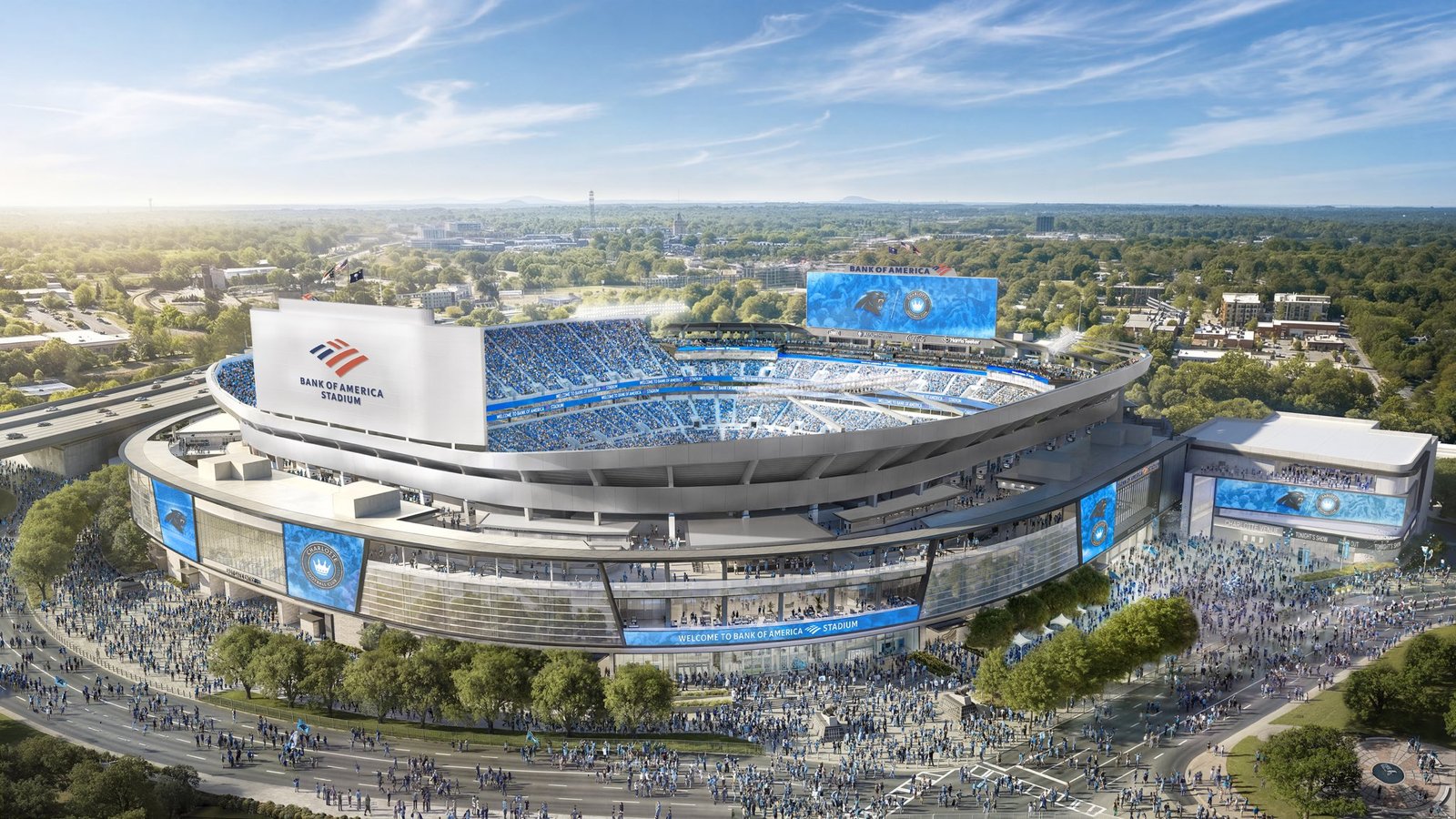
Rendering courtesy Carolina Panthers / Tepper Sports & Entertainment.
| Total cost (est.) | $1.3B total as announced July 2026 ($800M original June 2024 package plus a further $500M of Tepper private capital) |
| Public share | ~$650M via Charlotte hospitality/tourism-tax bonds (city council approved 2023) |
| Private share | ~$650M from Tepper Sports & Entertainment (David Tepper controls the Panthers via TSE) |
| Financing mechanism | Municipal hospitality/tourism-tax bonds paired with team equity; no direct property-tax pledge |
| Naming rights | Bank of America (extended through 2036; full annual terms not disclosed) |
| Ownership | David Tepper (bought Panthers 2018 for $2.275B; current Forbes value ~$5B) |
| Timeline | Phased 2024-2030; interior work 2026, fan-facing construction from early 2027, no games missed during the build |
| Status | Under Construction |
Carolina chose the renovation path because the downtown Charlotte location is not replicable at any greenfield alternative in the region — the property sits inside the uptown employment core, on light rail, walking distance from the convention district and the largest concentration of Fortune-500 headquarters between DC and Atlanta. The 1996-vintage bowl is structurally sound; what the building lacks is modern premium-seating inventory, suite-level food-and-beverage revenue capture, and the sponsorship-signage density that priced into the SoFi and Allegiant benchmarks. Tepper's calculus with the city was straightforward: match the private commitment roughly dollar-for-dollar with hospitality-tax bonds — a public source paid by hotel and rental-car visitors rather than by resident property tax — and the team commits to a long-term lease extension keeping the Panthers and Charlotte FC (Tepper's MLS side, which also plays at the stadium) in the building past 2045. The renovation is a case study in the "modernize the operating platform, don't replace it" path, contrasting with the Chiefs' greenfield exploration below. Charlotte City Council approved the deal in 2023; construction is phased so the Panthers do not miss a home game.
New Chiefs Stadium — announced move to Kansas
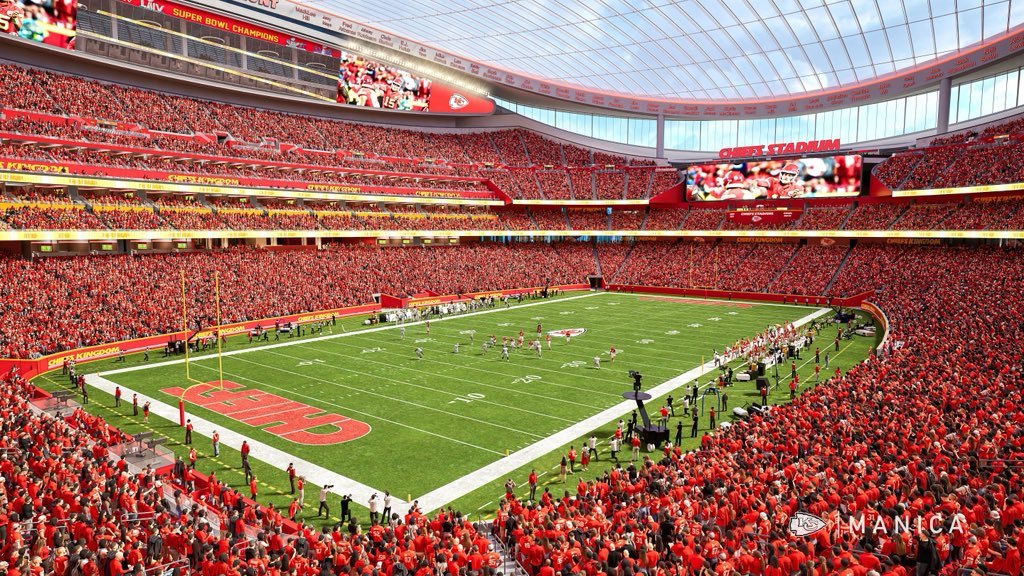
Rendering: Manica Architecture / Kansas City Chiefs.
| Decision announced | Late December 2025 (Hunt family selected Kansas over Missouri after the April 2024 Jackson County referendum failure) |
| Total cost (est.) | ~$3B (stadium + team HQ / practice facility + adjacent mixed-use development) |
| Site | Wyandotte County, Kansas — near the Kansas Speedway / Legends entertainment district. New team headquarters and practice facility to be built in Olathe, Kansas |
| Design | Fully enclosed dome with a fixed translucent ETFE roof; ~70,000 capacity; exterior and seating-bowl elements intended to echo Arrowhead's iconic shape while modernizing for noise, tailgating, and fan experience. Renderings released July 22, 2026. Lead design architect: MANICA (Kansas City-based); architect of record: HNTB |
| Public share | ~60% Kansas — STAR bonds (Sales Tax and Revenue) funded by future sales-tax revenue within the redevelopment district; no new broad state taxes in the stated structure. Becomes the largest STAR-bond project in Kansas history by a wide margin |
| Private share | ~40% Hunt family / Chiefs |
| Financing mechanism | Kansas STAR bonds — a Kansas-specific TIF-style mechanism that captures sales-tax growth inside a defined redevelopment district. The Kansas legislature expanded the STAR-bond authorization specifically to attract the Chiefs (and, in a paired track, the Royals) |
| Naming rights | TBD — will price at the top of the current NFL naming-rights band given the new-build premium and market profile |
| Ownership | Hunt family (Clark Hunt, chairman); Chiefs valued ~$6.2B per Forbes 2025 |
| Timeline | Groundbreaking anticipated late 2026 or early 2027; current Arrowhead lease runs through the 2030 season; new stadium opens for the 2031 NFL season |
| Status | Announced — Design Complete, Financing Structured |
The Chiefs decision is the reference case for how the leaving-town threat maximizes public financing. The April 2024 failure of the Jackson County sales-tax extension — which would have funded a renovated-plus-adjacent-development plan for the current Arrowhead site — reset the baseline. Missouri, having said no once, could not bid competitively against a Kansas offer explicitly designed to be more generous. Kansas responded with an expanded STAR-bond authorization that state legislators structured specifically to attract the Chiefs, and the Hunt family selected Kansas in late December 2025. The project will become the largest STAR-bond project in Kansas history by a wide margin. The soft-lobbying vector matters in retrospect: the Kelce family's national media platform functioned as demand-side pressure that materially advantaged the Kansas side. The current Arrowhead lease runs through the 2030 season, which anchors the new stadium's opening to the 2031 season. The strategic lesson for practitioner readers is that a two-state bidding war in a metropolitan area straddling a state line delivers materially higher public financing than a same-state renegotiation ever could — a template already being watched by owners in DMAs with similar cross-jurisdiction geography. Official Chiefs updates at chiefs.com/new-stadium.
New Highmark Stadium — Orchard Park, NY
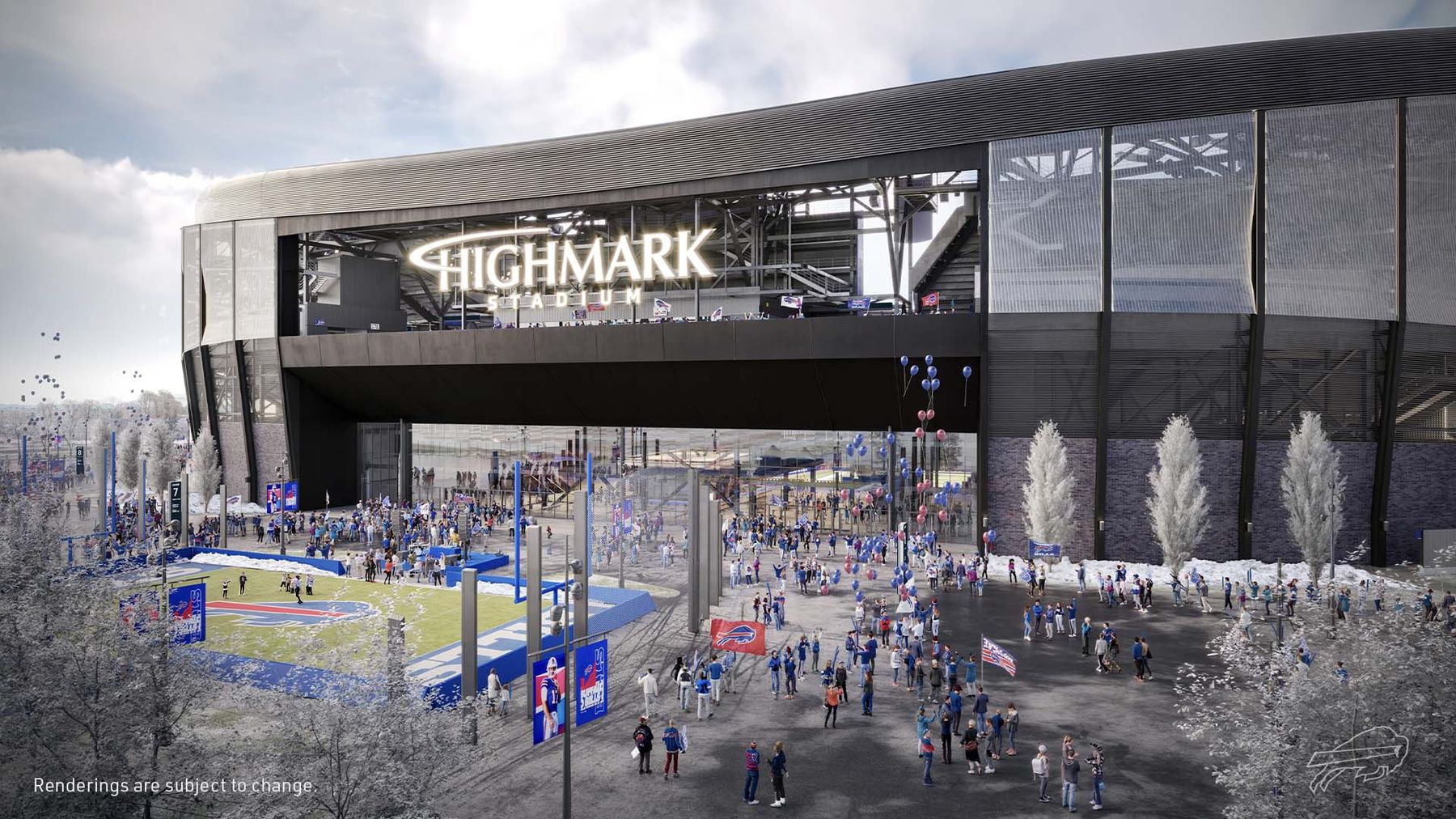
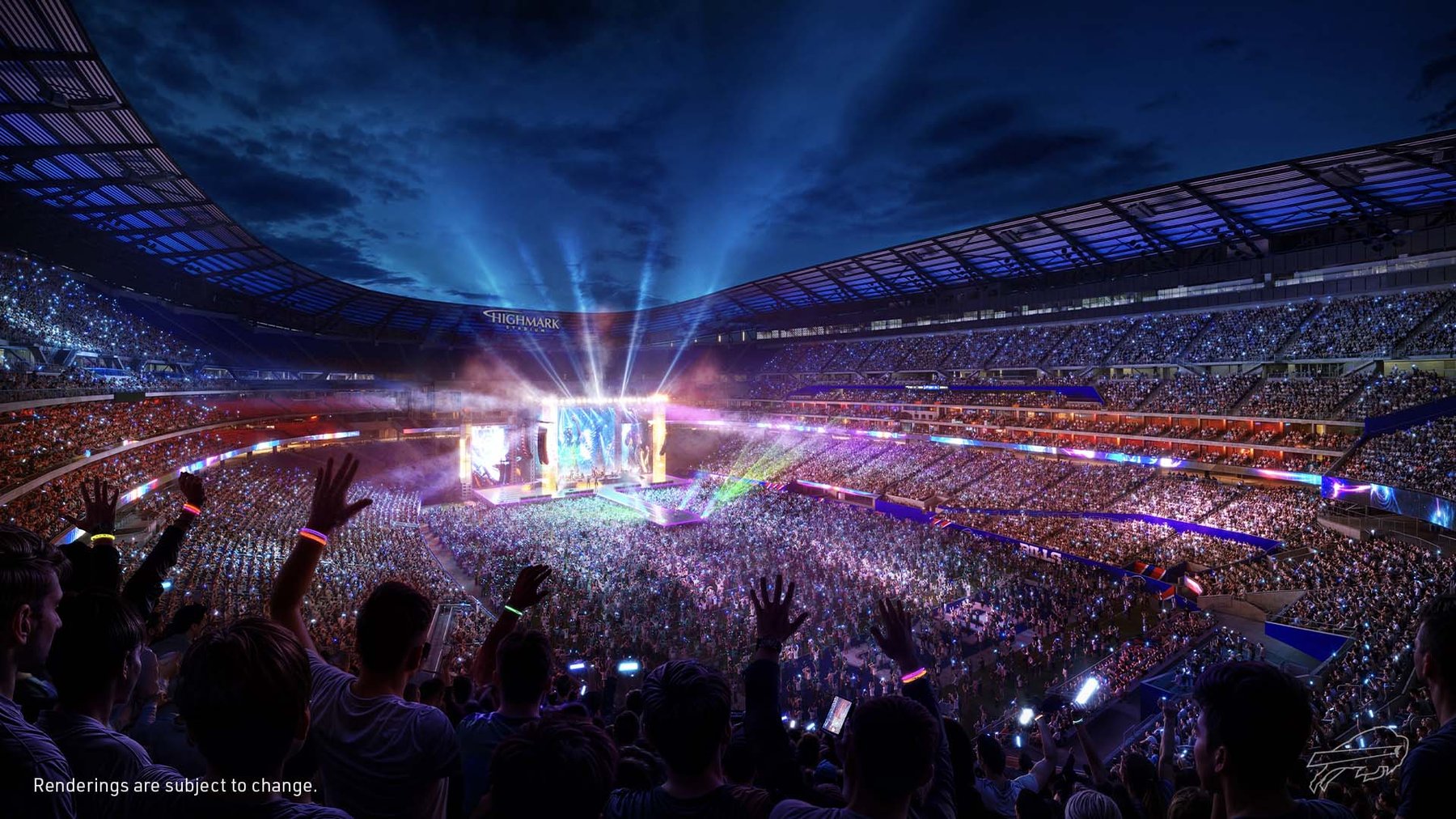
Renderings: Populous / Buffalo Bills.
| Total cost (est.) | ~$1.7B (open-air, ~60,000 seats, purpose-built across the parking lot from the current stadium) |
| Public share | ~$1.1B — New York State ~$850M plus Erie County ~$250M (largest state-level check ever committed to an NFL stadium at the time it was signed in 2022) |
| Private share | ~$550M team (Pegula Sports & Entertainment) plus ~$200M NFL G-4 interest-free loan |
| Financing mechanism | Direct state general-fund appropriation plus Erie County contribution funded via a mix of county revenue sources; unusual in the modern era for using direct-appropriation rather than dedicated hotel/tourism-tax bonds |
| Naming rights | Highmark (extended from the prior building; full annual terms not publicly disclosed) |
| Ownership | Terry & Kim Pegula (bought Bills 2014 for ~$1.4B; current Forbes value ~$4.6B) |
| Timeline | Under construction; opens 2026 season |
| Status | Under Construction — On Schedule |
The Bills deal is the reference point for every subsequent public-financing negotiation in the current wave. New York's decision in 2022 to commit $850M in state money — on top of $250M from Erie County — put the public share at roughly 65% of a $1.7B build, at the high end of the modern era and materially above the SoFi (~0% public), Mercedes-Benz (~12%), or Allegiant (~40%) benchmarks. The political logic was straightforward: Buffalo is a small-market team with credible leaving-town leverage (Austin, San Antonio, and Toronto were live alternatives in the earlier 2010s), and Governor Hochul made the political calculation that the cost of losing the Bills exceeded the cost of the appropriation. Every subsequent state-level negotiation — Tennessee for the Titans, Ohio for the Browns, Missouri and Kansas for the Chiefs, and the multi-jurisdiction fight over the Commanders — has referenced the Buffalo structure explicitly. Construction is on schedule for a 2026 opening; premium-seating and PSL revenue on the new building represents a material step-up versus the 1973-vintage predecessor and is the private-side return that justifies the Pegula equity check.
Tennessee Titans — New Nissan Stadium — Nashville, TN
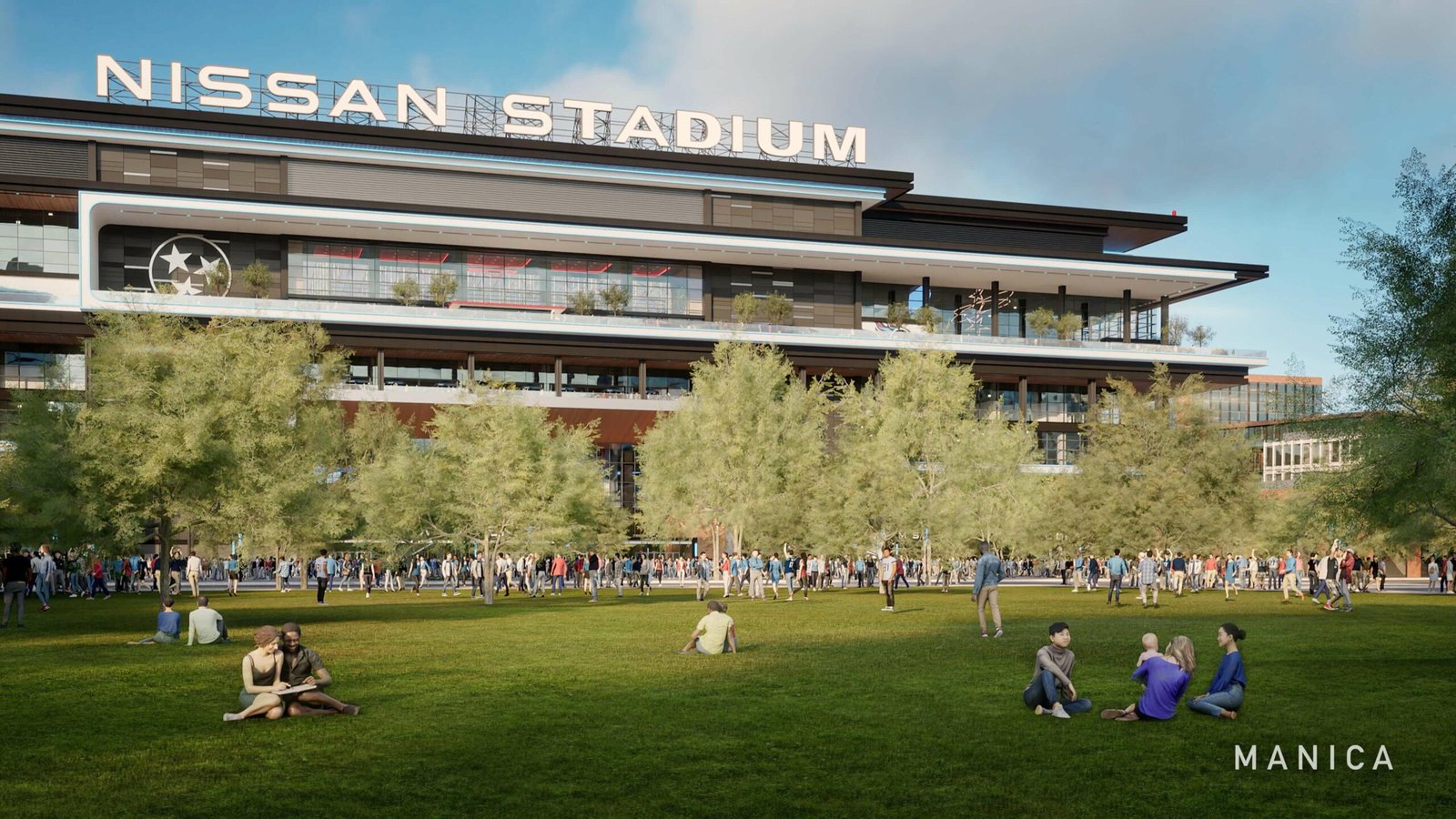
Rendering: Manica Architecture / Tennessee Titans.
| Total cost (est.) | ~$2.1B (domed, ~60,000 seats, East Bank of the Cumberland River adjacent to the existing Nissan Stadium footprint) |
| Public share | ~$1.26B — ~$760M in Tennessee state bonds plus ~$500M in Metro Nashville bonds backed by hotel/tourism occupancy tax and an in-stadium sales-tax capture |
| Private share | ~$840M team equity plus a $200M NFL G-4 interest-free loan; PSL revenue supplements the team check |
| Financing mechanism | State-issued general-obligation bonds paired with Metro Nashville revenue bonds pledged against hotel occupancy tax and stadium-district sales-tax capture; team equity plus G-4 |
| Naming rights | Nissan (extended, annual terms not publicly disclosed) |
| Ownership | Adams family (Amy Adams Strunk, Controlling Owner since 2015; family control since Bud Adams founded the franchise as the Houston Oilers in 1959) |
| Timeline | Under construction; opens 2027 NFL season |
| Status | Under Construction — ~40% Complete |
The Tennessee public-financing structure sits at the aggressive end of the current wave. The $760M state-level contribution exceeded any prior single-state stadium subsidy at the time it was approved, moving the reference ceiling that Buffalo had set in 2022. The Metro Nashville side works because the local economy has changed: hotel/tourism-tax receipts have grown roughly 40% since 2019 on the bachelor/bachelorette pipeline, the country-music tourism build-out, and the convention-and-entertainment district around Broadway. The bond math does not require a resident property-tax pledge, which was the political condition Metro insisted on. The non-game-day economics case is the concert booking pipeline — Taylor Swift, Beyoncé, Coldplay, U2, plus soccer friendlies and cross-league fixtures — already reserved years out, which is what allowed the public side to close on the private-share justification. On the ownership side, the Adams family sold minority stakes in the franchise across 2023-2025 to fund the equity contribution, a capital-allocation move worth naming: the family used the same underwriting discount that private-market minority interests carry in family-office estate planning. Compared to Bills Highmark (~$1.7B, similar public/private ratio at smaller absolute size), Titans is the current high-water mark for public-financing intensity per team.
Denver Broncos — New Stadium Concept — Denver, CO
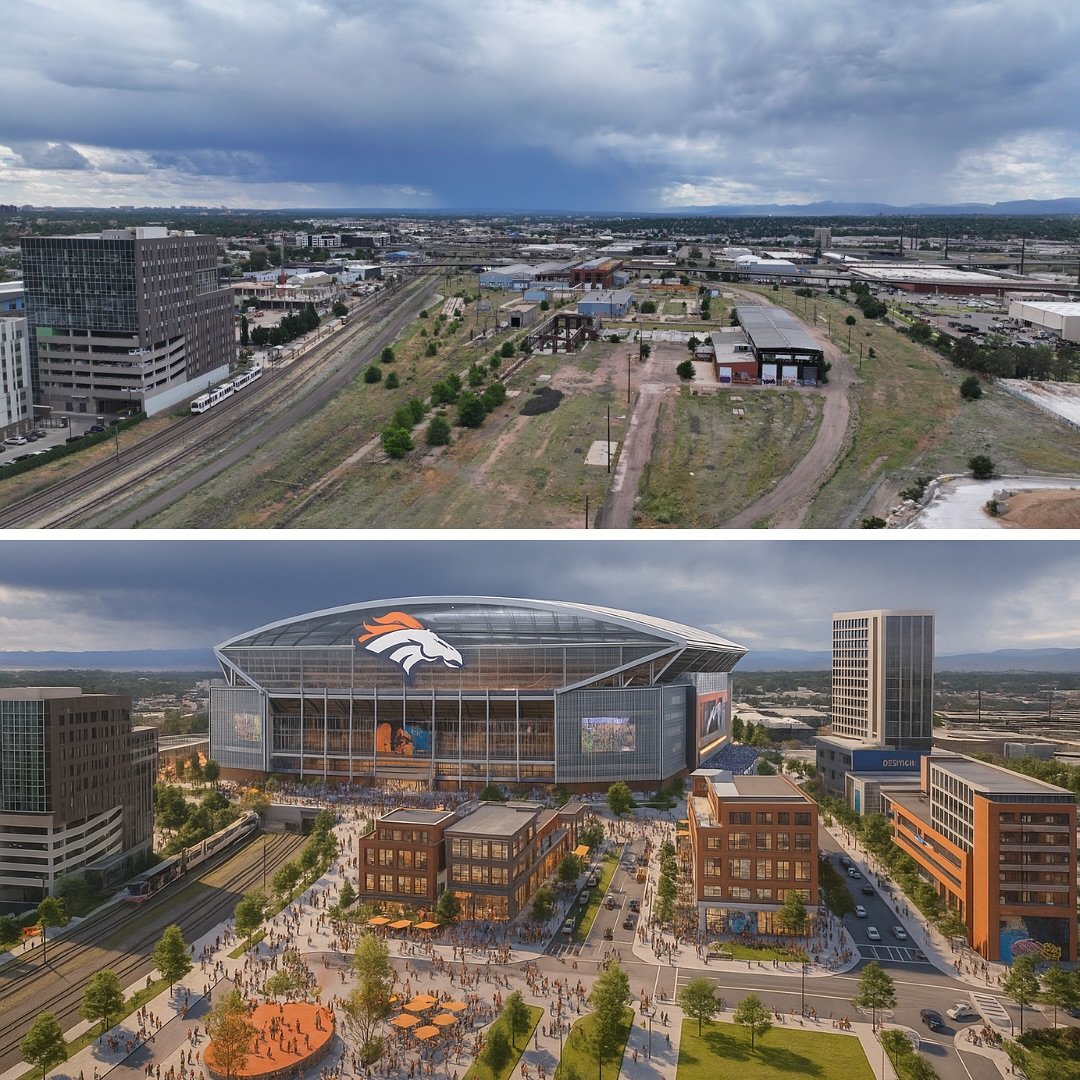
Rendering: Denver Broncos concept / architect TBD.
| Total cost (est.) | TBD — early concept; mid-to-high estimates in the $3-4B range given site-preparation and mixed-use scope |
| Public share | TBD — Colorado has limited recent history of major NFL stadium public financing; appetite for a new round is politically uncertain. Empower Field at Mile High (2001) was ~65% publicly-funded via the Metropolitan Football Stadium District 0.1% sales tax, retired in 2011 |
| Private share | TBD — the Walton-Penner Ownership Group has extraordinary capital capacity relative to peers; the group paid a then-record $4.65B for the franchise in 2022 |
| Financing mechanism | TBD — likely metropolitan Denver sports-authority financing if the public side participates, plus Walton-Penner equity and NFL G-4 |
| Naming rights | Current: Empower Field at Mile High (Empower Retirement, term through 2033). New-build naming rights fully open |
| Ownership | Walton-Penner Family Ownership Group (Rob Walton chairman; Greg Penner CEO; Carrie Walton Penner) — the most well-capitalized ownership group in the NFL |
| Timeline | Concept phase; Empower Field lease expires 2030; site selection expected 2026-2027; opening no earlier than 2031-2032 |
| Status | Concept / Early Planning |
The Walton-Penner group is the singular strategic capital story of the current stadium wave. The $4.65B 2022 franchise purchase was the highest ever paid for an NFL team, and the group's aggregate liquid capacity to write private-share checks is arguably higher than any other NFL ownership. That changes the political math on the public side: Denver can plausibly ask the team to fund more of the build than Cleveland or Buffalo could realistically demand from the Haslams or Pegulas. The proposed site sits in the current rail-yard area near downtown Denver adjacent to Ball Arena. The before-and-after rendering shows the transformation from industrial-adjacent brownfield to stadium plus mixed-use district — the scale of the neighborhood change, not the stadium in isolation, is the reason this project is more than a stadium project. The reference comps for that site play matter: Populous's Chicago Bears "The 78" concept for a similar rail-adjacent Chicago site is the cautionary tale; Detroit's Corktown / Ford Field precedent and Atlanta's Battery Atlanta (Braves) adjacent development — which generated an estimated ~$2B in secondary real-estate value — are the working models. Empower Field will be only 24 years old at planned move-out, one of the youngest NFL stadiums ever replaced. The justification is not physical obsolescence but the modern-venue revenue-per-seat gap that the current bowl cannot close.
New Commanders Stadium — RFK site (DC), Northern Virginia, or Maryland
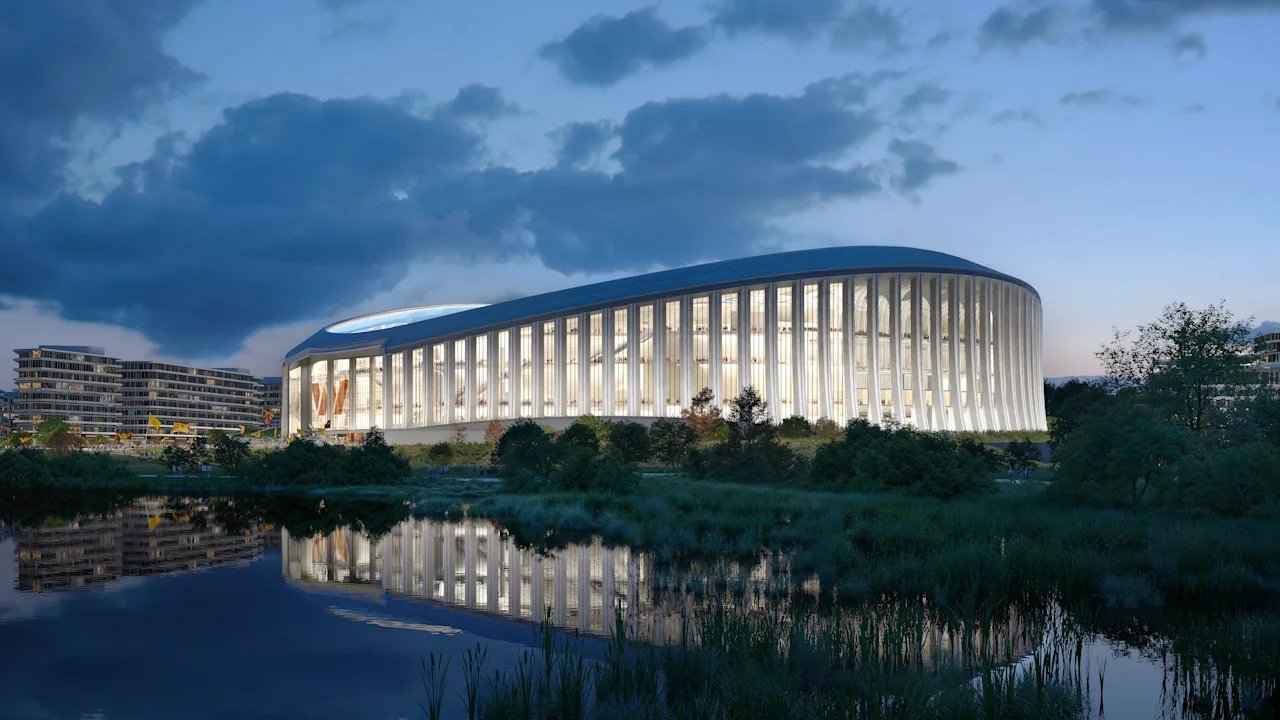
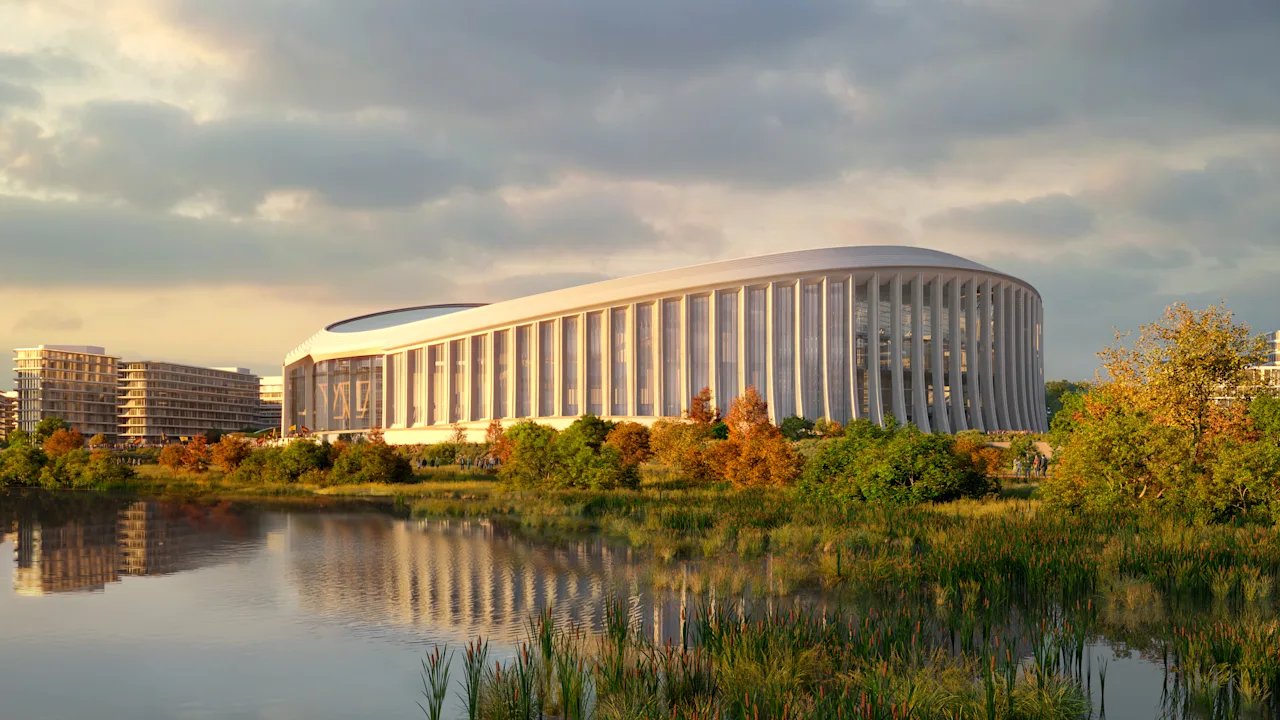
Renderings: concept design by Bjarke Ingels Group (reported) / Washington Commanders.
| Total cost (est.) | ~$3-4B including surrounding mixed-use development (stadium plus adjacent hotel, housing, retail, and entertainment components) |
| Public share | TBD by jurisdiction; DC, Virginia, and Maryland each offering competitive packages. DC gained federal authority over the RFK site via legislation Congress passed in December 2024 |
| Private share | Balance from the Harris ownership group, including private-equity-adjacent capital-stack construction (Josh Harris co-founded Apollo Global) |
| Financing mechanism | If DC (RFK site): DC-issued bonds against dedicated revenue plus federal land transfer already secured. If Virginia: Loudoun County or Prince William County TIF-plus-state-support package. If Maryland: renewal of Prince George's County structure with expanded state commitment |
| Naming rights | TBD (Northwest Stadium naming is on the current Landover building only) |
| Ownership | Josh Harris ownership group (bought Commanders 2023 for $6.05B — then North American sports-franchise record) |
| Timeline | Site decision expected 2026-2027; earliest realistic opening 2030+ |
| Status | Three-Way Site Contest |
The Commanders decision is the highest-stakes stadium site selection of the current wave for two reasons. First, the RFK site — the original Washington home from 1961 through 1996 — is emotionally central to the franchise's fanbase, and the December 2024 federal legislation transferring RFK site control to DC reopened an option that had been closed for a decade. The return-to-DC narrative is politically powerful in a way that a suburban Virginia or Maryland site cannot match. Second, all three jurisdictions have credible incentive packages on the table, which sets up a bidding war structurally similar to the Chiefs' Missouri-vs-Kansas contest but at higher dollar magnitude given the DMA-9 Washington market. The Harris ownership group's private-equity background suggests a district-development capital-stack approach closer to the Kroenke Hollywood Park model than a stand-alone stadium build — the four renderings released signal a mixed-use vision with the stadium as the anchor tenant of a broader real-estate program, not the sole product. Bjarke Ingels Group is the reported design lead for the RFK concept; the final architect and site announcement remain pending.
Brook Park Domed Stadium concept — Cleveland (Cuyahoga County), OH
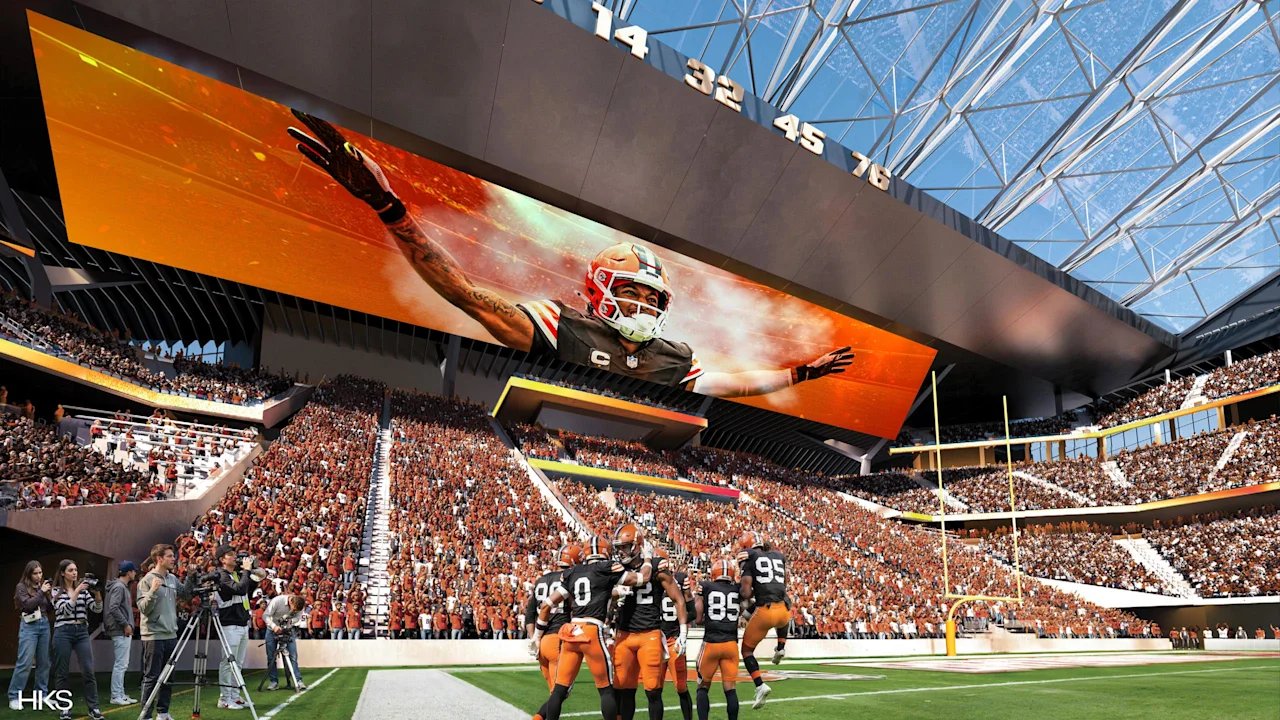
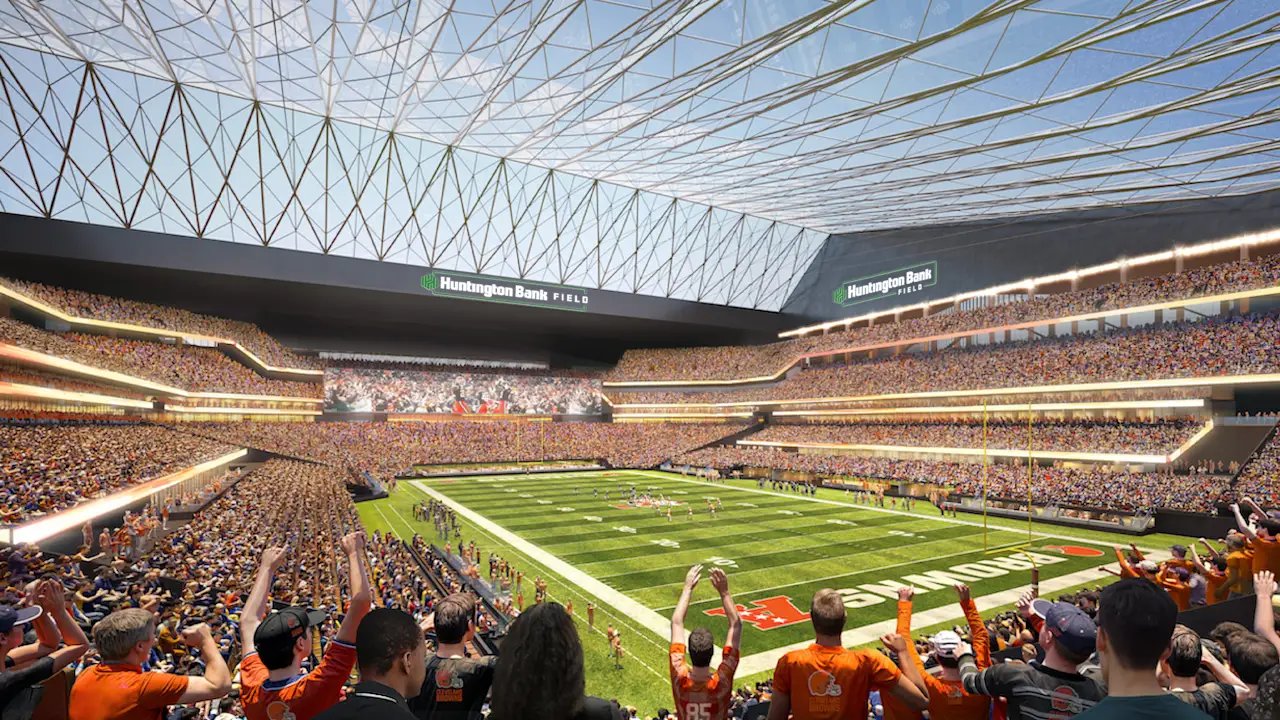
Renderings: HKS Architects / Cleveland Browns.
| Total cost (est.) | ~$2.4B for a new domed stadium in suburban Brook Park, ~15 miles southwest of downtown Cleveland |
| Public share | ~$1.2B sought — roughly split between State of Ohio (financing referendum pending) and Cuyahoga County; final structure unresolved |
| Private share | ~$1.2B from Haslam Sports Group (Jimmy & Dee Haslam) |
| Financing mechanism | Proposed state-level bond authorization pending; county-level TIF/tourism structure under negotiation. Cleveland downtown alternative continues to exist as a legal and political counterweight, with municipal litigation possible if the suburban site advances over city objections |
| Naming rights | Huntington Bank (moved from FirstEnergy in 2024; naming to migrate to any new build under current terms) |
| Ownership | Haslam Sports Group (Jimmy & Dee Haslam; also own the NBA Milwaukee Bucks minority stake and Pilot Company travel-center chain) |
| Timeline | Contentious — state and county approvals pending; earliest opening 2029+ |
| Status | Contested — Financing Pending |
The Browns project is the most legally and politically contested stadium build in the current wave. The Haslams' proposal to move to a domed suburban stadium in Brook Park sits in direct conflict with the City of Cleveland's determination to keep the team at the existing Huntington Bank Field lakefront site, whose current lease expires in 2028. The city has already signaled willingness to litigate under an Ohio-specific statute known as the Modell Law — enacted after the original Browns' 1995 relocation to Baltimore — that constrains publicly-funded professional-sports teams from relocating without offering the local community a purchase opportunity. The strategic case for the dome is real: a covered venue enables year-round non-game revenue (Final Fours, WrestleMania rotations, major concerts, the Big Ten championship game) that outdoor lakefront Cleveland can never host, and shoulder-season concert bookings currently leak to Columbus and Cincinnati. The counter-case from the city is that abandoning the lakefront destroys a decade of downtown-development momentum and that the marginal public dollar has better uses. The Ohio state-financing referendum is the pivotal event. Watch the political timeline as closely as the construction timeline.
EverBank "Stadium of the Future" — Jacksonville, FL
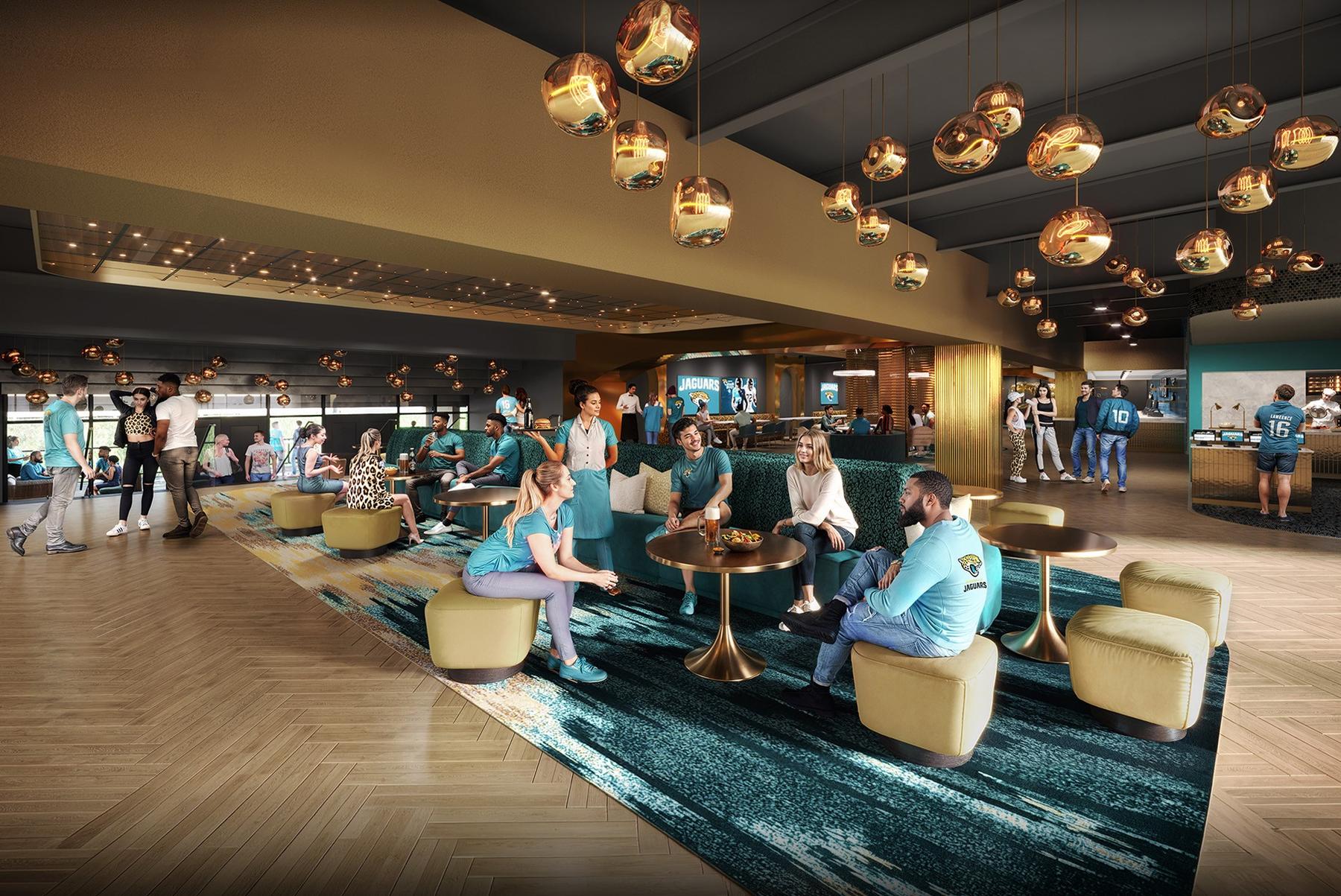
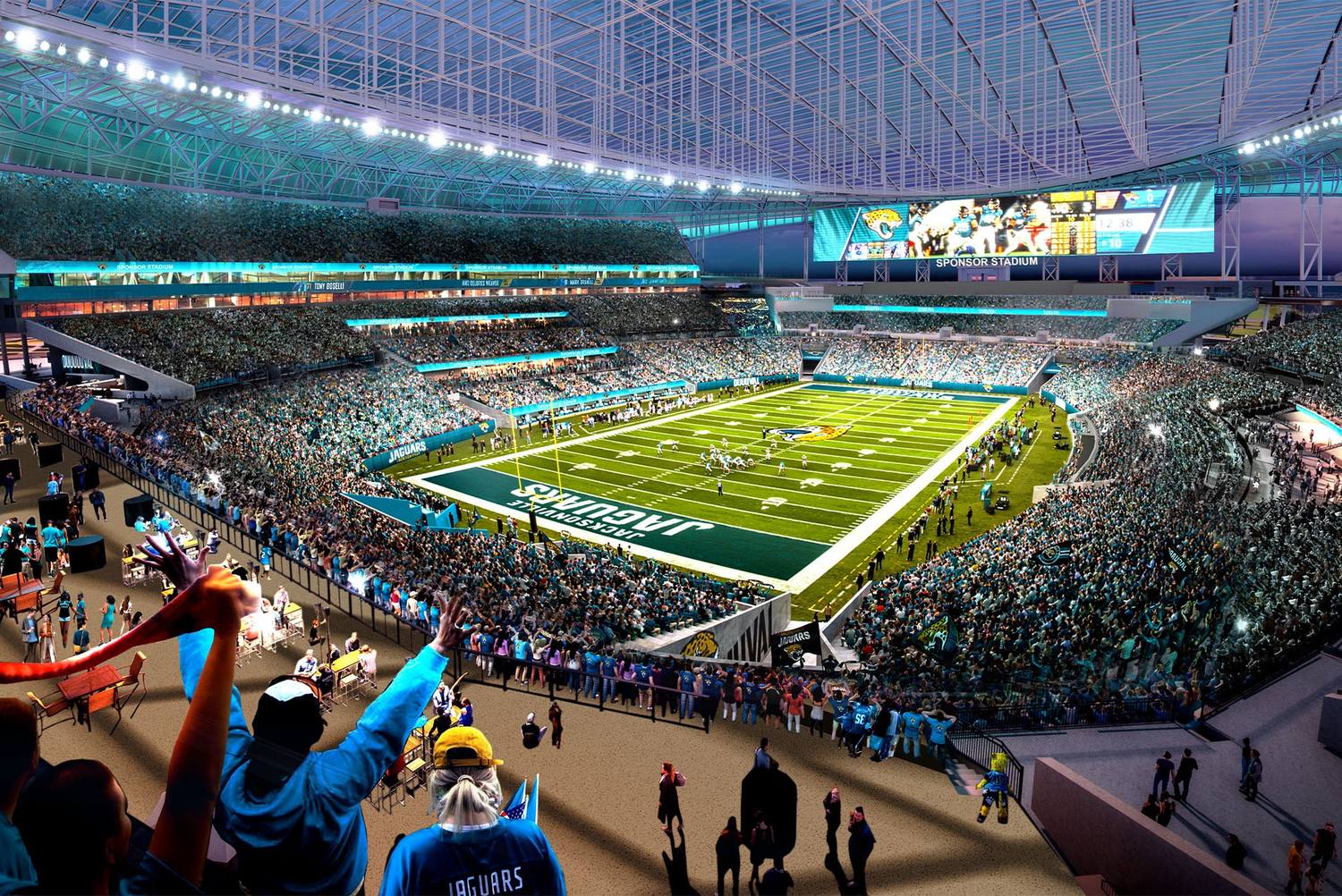
Renderings: HOK / Jacksonville Jaguars — "Stadium of the Future."
| Total cost (est.) | ~$1.4B renovation of EverBank Stadium (near-total rebuild while preserving the existing site footprint) |
| Public share | $775M from the City of Jacksonville, funded via extended sales-tax and tourism-development-tax authorization, per the June 25, 2024 city agreement |
| Private share | $625M from Shad Khan (also owns Fulham FC in the English Premier League and Flex-N-Gate auto-components group) |
| Financing mechanism | Municipal bonds against extended sales-tax and tourism-development-tax pledge; no direct property-tax exposure. Adjacent Khan-funded mixed-use development includes marina, entertainment complex, and hotel components |
| Naming rights | EverBank (naming rights extended concurrent with the renovation approval) |
| Ownership | Shad Khan (bought Jaguars 2011 for ~$770M; current Forbes value ~$4.2B) |
| Timeline | Phased 2025-2028; 2026 season in Jacksonville at a reduced 42,507 capacity with the upper deck closed plus two London home games, 2027 home slate at Camping World Stadium in Orlando under a one-year lease NFL owners approved in spring 2026, full opening for the 2028 season |
| Status | Under Construction — Phased |
The Jaguars project is unique in the wave: it is nominally a renovation but will replace nearly every seat and structural element while retaining the site. Khan's calculus was three-part. First, Jacksonville is the smallest DMA in the NFL (DMA #43), and any credible relocation threat would eventually have to acknowledge that most alternative markets already have teams — the modernization play is the more durable long-term option. Second, the City Council's unanimous approval of the extended sales-tax and tourism-tax package removed the political-risk overhang that has stalled similar projects in Cleveland and Cincinnati. Third, the London game series (Khan owns Fulham FC and the Jaguars have played a London home game in every season since 2013 but 2020) covers part of the home slate during peak construction — but it does not cover all of it. The 2026 season is played in Jacksonville with the upper deck closed and capacity cut to 42,507, and for the 2027 season the club leaves the market entirely for the 65,000-seat Camping World Stadium in Orlando under a one-year lease NFL owners approved in spring 2026, with one 2027 game still set for Wembley. HOK is the design lead. Adjacent Khan-funded mixed-use development — marina, entertainment complex, hotel — captures the surrounding real-estate uplift alongside the stadium program, following the Kroenke Hollywood Park playbook at a Jacksonville-appropriate scale. This is the deal in the wave that most closely mirrors the Panthers' renovation-in-place logic, adjusted for a much smaller market and a more aggressive scope.