Institute Essay · Reindustrialization
Atelier Missor — Titanium Statues and the Reindustrialization Aesthetic
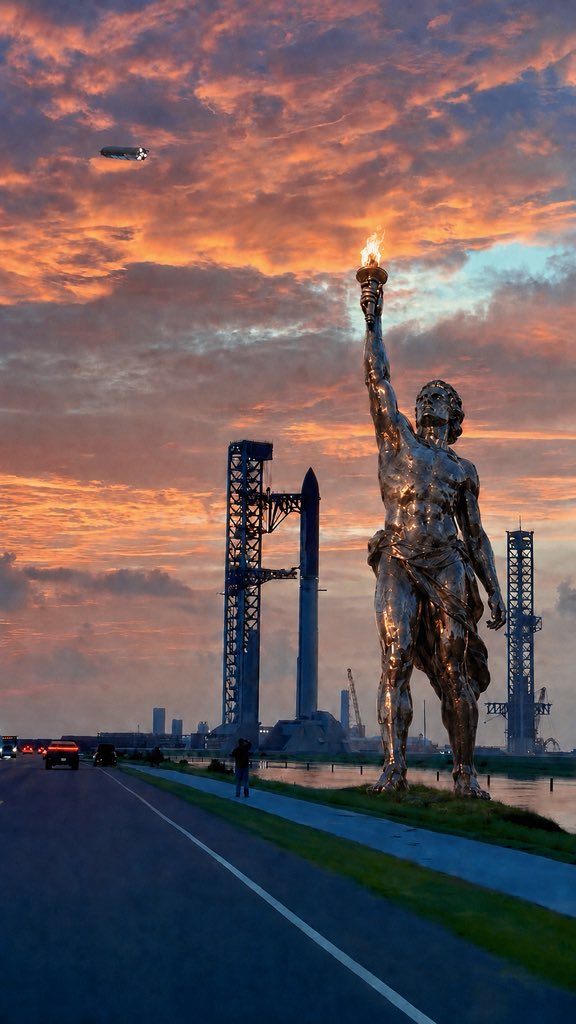
Atelier Missor is a young French-founded atelier that is casting gigantic titanium statues and placing them in specific locations across the American landscape. The first major placement is Prometheus — a 50-foot titanium figure holding the torch of the West — adjacent to Starbase, Boca Chica, Texas, the SpaceX launch facility from which the company intends to become interplanetary.
One of the earliest public voices on the piece framed it exactly right:
“We do this because Starbase is the one completely awesome thing on earth right now. And the last time the French made a statue celebrating America it launched the greatest century any country has ever seen. We’re back.” — Denis Labelle (@DenisLabelle) on X, on Atelier Missor’s Prometheus at Starbase
The historical bracket is worth holding onto. The last time a French atelier made a monumental gift to America was 1886 — Bartholdi’s Liberty Enlightening the World, arriving in New York Harbor at the beginning of what became the American Century. The parallel is not accidental. Prometheus is titanium, not copper, and it stands next to a launch facility rather than a shipping harbor — but the civilizational proposition is the same shape. A French sculptural work, gifted to America, at the moment America is doing something no civilization has done before. Bartholdi’s Liberty preceded the American ascent. Atelier Missor’s Prometheus is placed at the moment America is attempting to extend that ascent off-planet. The atelier’s own manifesto puts it more directly:
“Gigantic titanium statues will lead us to a beautiful future. Great men have always walked in the footsteps of statues. Titanium does not corrode. It endures for millions of years. When a civilization reaches a certain level of technological development, it begins to craft its monuments from titanium. Let us become that advanced civilization. Let gigantic titanium statues guide us to that beautiful future.” — Atelier Missor
That is a statement of belief. It is not a marketing tagline, not a policy program, not a business plan. It is a claim about what a civilization worth building looks like, and about what it takes physically — and materially — to build it.
The Institute is a publisher of practitioner-reference material, not an arts publication. This essay is here because the atelier’s work fits the reindustrialization thesis we have argued in the Institute’s energy-policy and industrial-policy writing, and because the aesthetic proposition is worth taking seriously on its own terms.
Titanium is not a decorative material choice. It is a manufacturing-capacity claim.
Casting titanium at monumental scale requires specific industrial infrastructure. The metal has a melting point of 1,668°C, is highly reactive with oxygen and nitrogen at those temperatures, and requires vacuum-arc or plasma-arc melting in specialized furnaces. The pouring and cooling process for a large casting has to happen in inert-atmosphere or vacuum environments. Post-cast machining requires tooling and expertise that only a small number of foundries worldwide possess. The supply chain for titanium sponge (the raw feedstock) is dominated by Japan, China, Russia, and Kazakhstan — not the United States.
The choice to cast a gigantic statue from titanium therefore is not just an artistic decision. It is a decision to invoke, deploy, and depend on the entire industrial stack that produces and works titanium at scale. It says something about what the atelier believes the physical world should be capable of, and it says something about what the atelier is willing to fund into existence so that capability persists.
A civilization that can only cast monuments from bronze is not the same civilization that can cast them from titanium. And a civilization that could once cast them from titanium, and has forgotten how, is a civilization in decline.
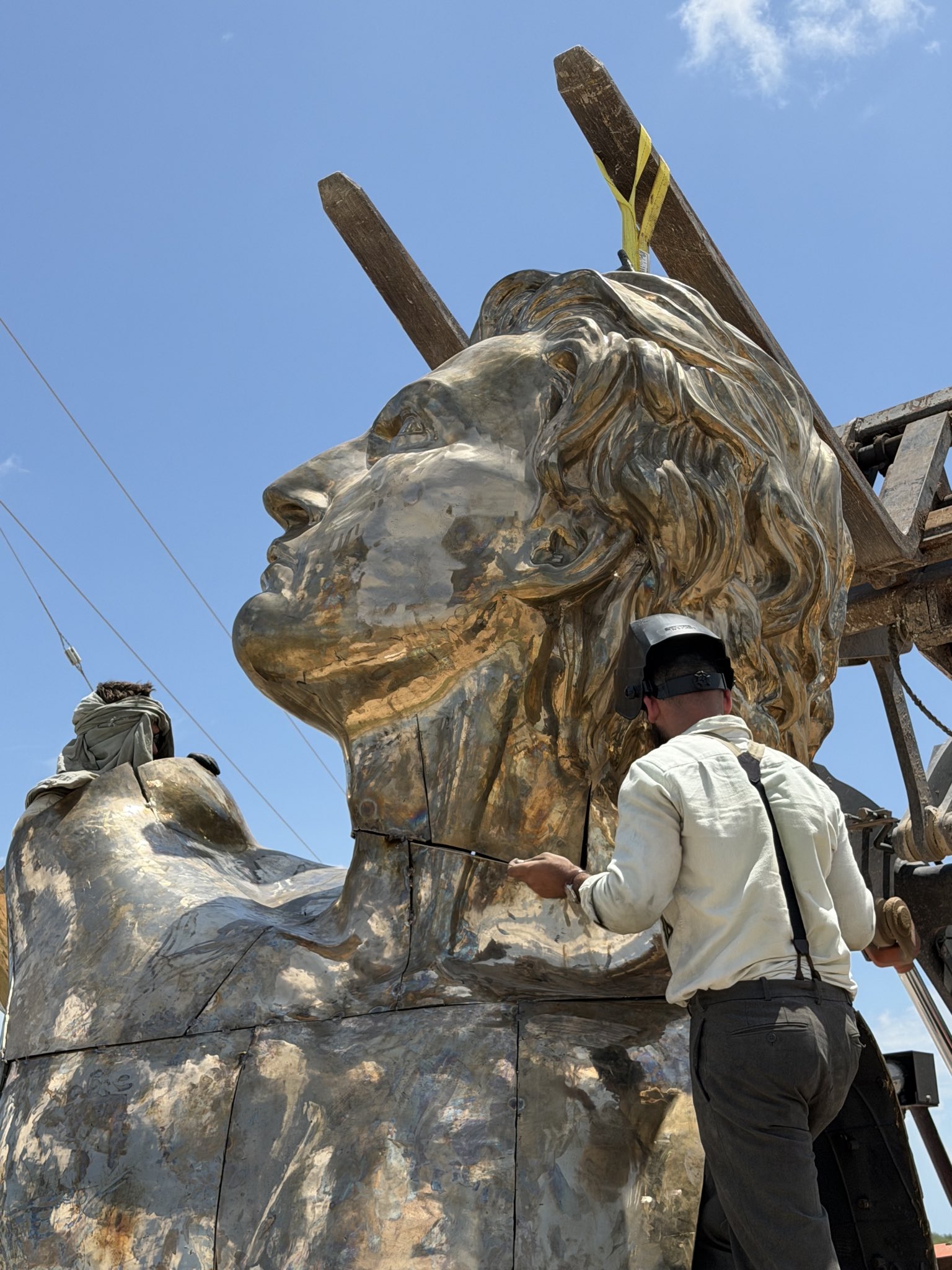
The physical location matters as much as the material. The atelier is placing Prometheus next to Starbase, in Boca Chica, Texas. Starbase is the launch facility for SpaceX’s Starship program — the vehicle SpaceX intends to use to make humanity multi-planetary. It is one of the two or three places in the world where the physical work of getting off the planet is being performed, in public, by a private company that has decided the timeline is inside a decade.
Putting a monumental titanium statue next to a launch facility does argumentative work that no essay can. It says: this is what humans do when they are trying to become a great civilization. Not next to a museum. Not next to a park. Next to the future being built. The physical adjacency is the argument.
The Institute’s reindustrialization thesis, argued across the energy-policy and industrial-policy writing on this site, is that the United States has spent forty years off-shoring the physical stack that makes advanced manufacturing possible — and that the country now has to rebuild it, at speed, if it wants to remain a great civilization in the material sense. That means grain-oriented electrical steel, high-voltage transformers, semiconductor fabrication, energetic materials, precision-machined castings, and the workforce and permitting infrastructure that allow all of those to exist at scale.
The reindustrialization thesis is usually argued in engineering, economic, and policy terms. Atelier Missor is arguing it in aesthetic terms. The claim is that the material choices a civilization makes for its public objects are a signal — both to itself and to observers — of what the civilization believes it is capable of. Bronze statues in 400 BC were a claim about Greek metallurgy. Cast-iron ornament in 1880 was a claim about the Bessemer process and industrial-scale iron production. Steel-and-glass skyscrapers in 1930 were a claim about American structural engineering. Titanium monuments in 2026 would be a claim about a civilization that has recovered its capacity to produce, work, and deploy the most demanding metals at monumental scale.
This is a different register of argument than the Institute typically writes in, and it is a register that deserves respect on its own terms. Policy briefs and industrial-capacity analyses reach the reader through the analytical mind. Monuments reach the reader through the physical experience of being in their presence. Both are legitimate ways to argue for the same conclusion.
Most of the Institute’s writing is about specific technical questions — tax treatment, entity architecture, deal structure, valuation frameworks. Atelier Missor is not a practitioner reference. But the atelier’s posture has three lessons that carry over to how practitioners at the Institute’s target audience — family-office CFOs, top-tier advisors, principal decision-makers — think about their own work.
First: physical form carries signal. A bound reference book that sits on a desk for twenty years is not the same artifact as a searchable PDF that lives in a downloads folder for six months. A cast-titanium monument is not the same object as a rendered image. The physical form is part of the argument the object makes.
Second: craft that endures is a different investment class than craft that entertains. The reference books that practitioners still cite decades after publication were built by people who understood they were making something for the long arc. The same is true of the objects a civilization inherits.
Third: proximity to serious work matters. Placing a monument next to Starbase is not incidental. The company an artifact keeps — physically, editorially, institutionally — is part of what the artifact says. This is the same logic that puts a practitioner-reference publisher next to the specific tax code section and the specific case citation, rather than next to the general interest and the entertainment adjacency.
The atelier publishes new work on X, YouTube, and Instagram. The site itself is the reference point for what is being cast, where each piece is going, and how the atelier articulates the project. This is one of those rare cases where the primary source is the best source; there is no journalism about the atelier that is more articulate than the atelier’s own manifesto.
Founded to cast gigantic titanium statues and place them in specific locations. First large placement adjacent to Starbase in Boca Chica, Texas.
The Institute has no affiliation with Atelier Missor. This essay was written after encountering the atelier’s work independently and finding that its posture fit the reindustrialization thesis the Institute has argued elsewhere. There is no compensation, no partnership, and no editorial arrangement.
The Institute is a publisher operating under the Lowe v. SEC publisher exception. Nothing in this essay is investment advice.